MB-230 · Question #243
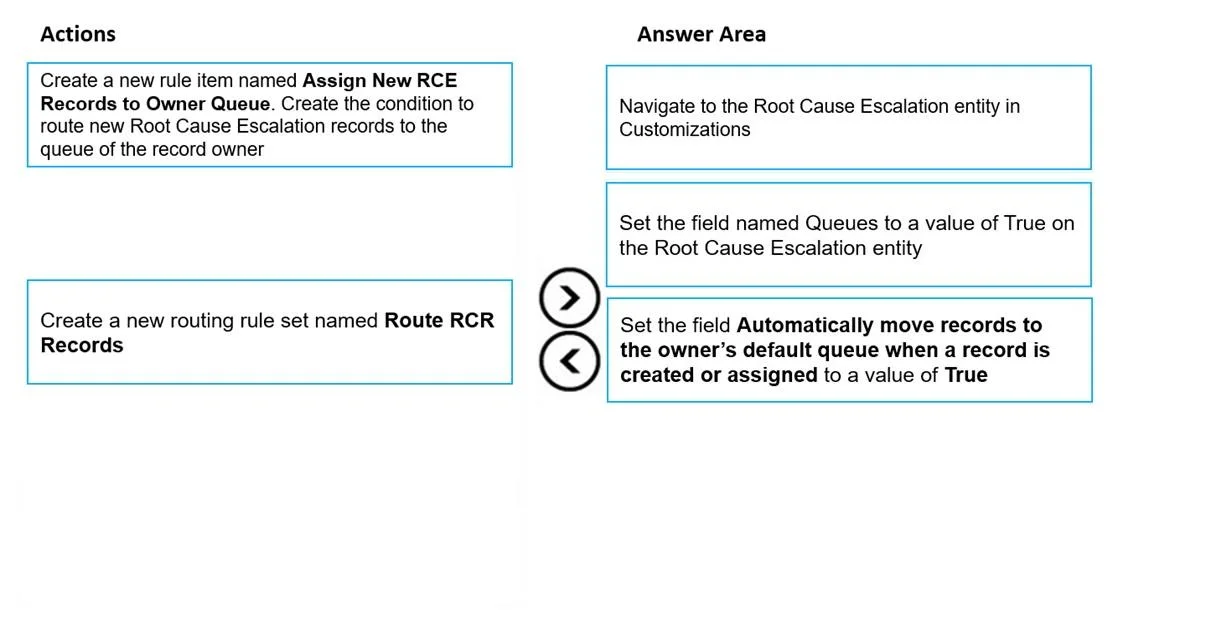
Drag and Drop Question You are a Dynamics 365 Customer Service administrator. You create a new entity named Root Cause Escalation. Queues must be used for new Root Cause Escalation records. The…
The correct answer is Navigate to the Root Cause Escalation entity in Customizations; Set the field named Queues to a value of True on the Root Cause Escalation entity; Set the field Automatically move records to the owner's default queue when a record is created or assigned to a value of True. Dynamics 365: Enabling Queues for a Custom Entity The Core Concept In Dynamics 365, custom entities do not have queue functionality enabled by default. To make an entity queue-enabled and configure auto-assignment behavior, you work at the entity definition level - not through…
Question
Exhibit
Answer Area
Drag items
Correct arrangement
- Navigate to the Root Cause Escalation entity in Customizations
- Set the field named Queues to a value of True on the Root Cause Escalation entity
- Set the field Automatically move records to the owner's default queue when a record is created or assigned to a value of True
Explanation
Dynamics 365: Enabling Queues for a Custom Entity
The Core Concept
In Dynamics 365, custom entities do not have queue functionality enabled by default. To make an entity queue-enabled and configure auto-assignment behavior, you work at the entity definition level - not through routing rules - when the requirement is simply "assign to owner's default queue."
Why These Three, In This Order
Step 1: Navigate to the Root Cause Escalation entity in Customizations
This is the mandatory starting point. You cannot modify entity-level settings without first opening the entity in the customization area (Settings > Customizations > Customize the System > Entities). Nothing else is possible until you are on the entity's configuration page.
Step 2: Set the field named Queues to a value of True
This enables queue support for the entity. By default, custom entities cannot be added to queues at all. Flipping this to True registers the entity as "queue-enabled." This step is a prerequisite for Step 3 - the auto-move setting is logically dependent on queues being enabled first; you cannot auto-route to a queue if the entity doesn't support queues.
Step 3: Set "Automatically move records to the owner's default queue when a record is created or assigned" to True
This is the built-in Dynamics 365 setting that directly fulfills the business requirement. Once queues are enabled, this checkbox automates assignment without any custom logic. This comes last because it depends on Step 2 being complete.
Why the Other Two Items Are Wrong
| Distractor | Why It's Wrong |
|---|---|
| Create a routing rule set named "Route RCR Records" | Routing rule sets are for complex conditional routing (e.g., route by case type, priority, customer). The requirement here is simple: route to the owner's default queue. A built-in entity setting already does this. |
| Create a rule item "Assign New RCE Records to Owner Queue" | Rule items belong inside routing rule sets. Same problem - this is the wrong tool for a straightforward default-queue assignment. It adds unnecessary complexity. |
Common Misconceptions
- "I need routing rules to auto-assign to a queue." No - routing rules solve complex multi-queue routing. The entity-level auto-move toggle handles the simple "owner's default queue" scenario natively.
- "I can enable auto-move before enabling queues." The auto-move option is either unavailable or meaningless unless the entity is queue-enabled first. Always enable
Queues = Truebefore touching the auto-move setting. - "The order of Steps 2 and 3 doesn't matter." It does - Step 2 is a hard prerequisite for Step 3 to be valid.
Topics
Community Discussion
No community discussion yet for this question.