
S90-09A · Question #6
Service A is a utility service that provides generic data access logic to a database that contains data that is periodically replicated from a shared database (1). Because the Standardized Service…
Sign in or unlock S90-09A to reveal the answer and full explanation for question #6. The question stem and answer options stay visible for context.
Question
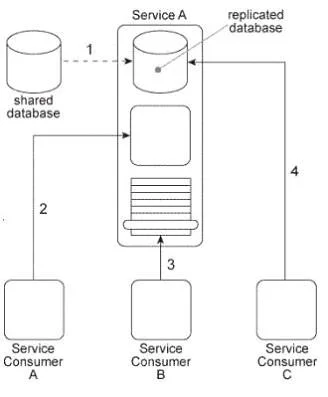
Service A is a utility service that provides generic data access logic to a database that contains data that is periodically replicated from a shared database (1). Because the Standardized Service Contract principle was applied to the design of Service A, its service contract has been fully standardized. Service A is being accessed by three service consumers. Service Consumer A accesses a component that is part of the Service A implementation by invoking it directly (2). Service Consumer B invokes Service A by accessing its service contract (3). Service Consumer C directly accesses the replicated database that is part of the Service A implementation (4). You've been told that the reason Service Consumers A and C bypass the published Service A service contract is because, for security reasons, they are not allowed to access a subset of the operations in the WSDL definition that expresses the service contract. How can the Service A architecture be changed to enforce these security restrictions while avoiding negative forms of coupling?
Exhibit
Options
- AThe Contract Centralization pattern can be applied to force all service consumers to access the
- BThe Contract Centralization pattern can be applied to force service consumers to access the
- CThe Concurrent Contracts pattern can be applied to Service A in order to establish one or more
- DNone of the above.
Unlock S90-09A to see the answer
You've previewed enough free S90-09A questions. Unlock S90-09A for full answers, explanations, the timed quiz mode, progress tracking, and the master PDF. Question stem and options stay visible so you can still see what's on the exam.