
S90-09A · Question #22
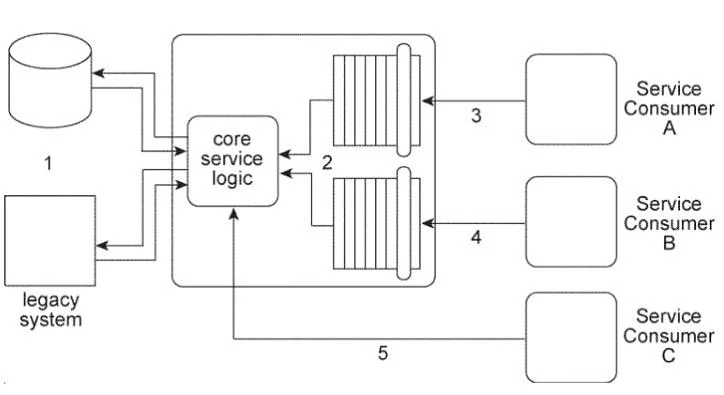
The architecture for Service A displayed in the Figure shows how the core logic of Service A has expanded over time to connect to a database and a proprietary legacy system (1) and to support two…
Sign in or unlock S90-09A to reveal the answer and full explanation for question #22. The question stem and answer options stay visible for context.
Question
The architecture for Service A displayed in the Figure shows how the core logic of Service A has expanded over time to connect to a database and a proprietary legacy system (1) and to support two separate service contracts (2) that are accessed by different service consumers. The service contracts are fully decoupled from the service logic. The service logic is therefore coupled to the service contracts and to the underlying implementation resources (the database and the legacy system). Service A currently has three service consumers. Service Consumer A and Service Consumer B access Service A's two service contracts (3, 4). Service Consumer C bypasses the service contracts and accesses the service logic directly (5). You are told that the database and legacy system that are currently being used by Service A are being replaced with different products. The two service contracts are completely decoupled from the core service logic, but there is still a concern that the introduction of the new products will cause the core service logic to behave differently than before. What steps can be taken to change the Service A architecture in preparation for the introduction of the new products so that the impact on Service Consumers A, B, and C is minimized?
Exhibit
Options
- AThe Service Abstraction principle can be applied to hide the implementation details from the core
- BA third service contract can be added together with the application of the Contract Centralization
- CThe Service Facade pattern can be applied to position Facade components between the core
- DNone of the above.
Unlock S90-09A to see the answer
You've previewed enough free S90-09A questions. Unlock S90-09A for full answers, explanations, the timed quiz mode, progress tracking, and the master PDF. Question stem and options stay visible so you can still see what's on the exam.