
S90-09A · Question #23
Service A. Service B. and Service C are each designed to access the same shared legacy system. The service contracts for Service A, Service B, and Service C are standardized and decoupled from the…
The correct answer is A. The Legacy Wrapper pattern can be applied together with the Standardized Service Contract. Option A is correct because the Legacy Wrapper pattern encapsulates the legacy system behind a single service façade, making it the sole integration point for all current and future services - so when the legacy system is replaced, only the wrapper needs to change, not Services…
Question
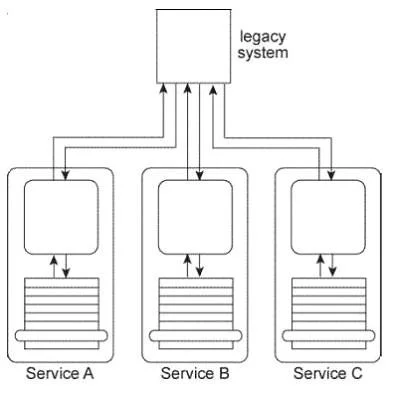
Service A. Service B. and Service C are each designed to access the same shared legacy system. The service contracts for Service A, Service B, and Service C are standardized and decoupled from the underlying service logic. Service A and Service B are agnostic services that are frequently reused by different service compositions. Service C is a non-agnostic task service that requires access to the legacy system in order to retrieve business rules required for the service to make runtime decisions that determine its service composition logic. The legacy system uses a proprietary file format that Services A, B, and C need to convert to and from. You are told that additional services need to be created, all of which need access to the legacy system. You are also told that the legacy system may be replaced in the near future. What steps can be taken to ensure that the replacement of the legacy system has a minimal impact on Services A, B, and C and any future services that are designed to rely upon it?
Exhibit
Options
- AThe Legacy Wrapper pattern can be applied together with the Standardized Service Contract
- BThe Legacy Wrapper pattern can be applied together with the Official Endpoint pattern so that the
- CThe Legacy Wrapper pattern can be applied together with the Data Format Transformation pattern
- DNone of the above.
How the community answered
(58 responses)- A55% (32)
- B16% (9)
- C7% (4)
- D22% (13)
Explanation
Option A is correct because the Legacy Wrapper pattern encapsulates the legacy system behind a single service façade, making it the sole integration point for all current and future services - so when the legacy system is replaced, only the wrapper needs to change, not Services A, B, C, or any future service. Pairing it with the Standardized Service Contract ensures the wrapper exposes a stable, decoupled interface, which aligns directly with the question's stated condition that service contracts are already standardized and decoupled from service logic.
Option B is wrong because the "Official Endpoint" pattern is not a recognized SOA pattern in this context, and even if it were, it does not address the decoupling of service contracts from the legacy system's implementation the way Standardized Service Contract does.
Option C is wrong because the Data Format Transformation pattern only solves the proprietary file format conversion problem - it does not isolate services from the legacy system's internals or protect them when the system is replaced. It's a supporting concern, not the solution to replacement impact.
Memory tip: Think "WRAP + STANDARDIZE" - the Legacy Wrapper wraps the legacy system (one place to swap when it changes), and the Standardized Service Contract standardizes the door into that wrapper (services never see what's behind it).
Topics
Community Discussion
No community discussion yet for this question.