
S90-09A · Question #39
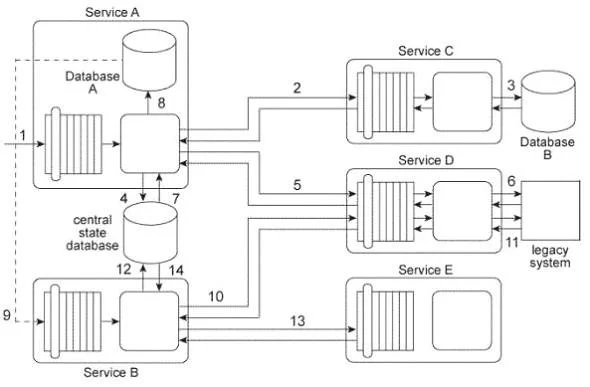
Service A is an orchestrated task service that is invoked by a separate composition initiator (1) and then sends a request message to Service C (2). Service C queries Database B to retrieve a large…
Sign in or unlock S90-09A to reveal the answer and full explanation for question #39. The question stem and answer options stay visible for context.
Question
Service A is an orchestrated task service that is invoked by a separate composition initiator (1) and then sends a request message to Service C (2). Service C queries Database B to retrieve a large data record (3) and provides this data in a response message that is sent back to Service A. Service A temporarily stores this data in a central state database (4) and then sends a request message to Service D (5), which accesses a legacy system API to retrieve a data value (6). Service D then sends this data value in a response message back to Service A. The data in the state database is subsequently retrieved by Service A (7) and merged with the newly received data value. This combined data is written to Database A (8), which triggers an event that results in the invocation of Service B (9). Service B is an orchestrated task service that sends a request message to Service D (10). which accesses a legacy system API to retrieve a data value (11) and then sends this data value in a response message back to Service B. Service B temporarily stores this data in a central state database (12) and then sends a request message to Service E (13), which performs a runtime calculation and then responds with the calculated data value back to Service B. The data in the state database is then retrieved by Service B (14) and merged with the calculated data value. Service B then uses the merged data to complete its business task. The following specific problems and requirements exist:
- Database B uses a proprietary data format that is not compliant with the XML format used by all
of the services in this service composition architecture This incompatibility needs to be solved in order to enable the described service message exchanges.
- The service contract provided by Service D does not comply with the data model standards that
were applied to the other services and therefore uses a different data model to represent the same type of data that is exchanged. This incompatibility needs to be solved in order to enable communication with Service D.
- Database B is a shared database that can be accessed by other services and applications
within the IT enterprise, which causes unpredictable runtime performance. This performance problem needs to be solved in order to make the runtime behavior of Service C more predictable.
- For performance and maintenance reasons, Service A and Service B need to be deployed in the
same physical environment where they can share a common state database. Upon reviewing these requirements it becomes evident to you that the Enterprise Service Bus compound pattern will need to be applied. However, there are additional requirements that need to be fulfilled. To build this service composition architecture, which patterns that is not associated with the Enterprise Service Bus compound pattern need to also be applied? (Be sure to choose only those patterns that relate directly to the requirements described above. Patterns associated with the Enterprise Service Bus compound pattern include both the required or core patterns that are part of the basic compound pattern and the optional patterns that can extend the basic compound pattern.)
Exhibit
Options
- AAtomic Service Transaction
- BCompensating Service Transaction
- CData Format Transformation
- DData Model Transformation
- EEvent-Driven Messaging
- FIntermediate Routing
- GPolicy Centralization
- HProcess Centralization
- IProtocol Bridging
- JRedundant Implementation
Unlock S90-09A to see the answer
You've previewed enough free S90-09A questions. Unlock S90-09A for full answers, explanations, the timed quiz mode, progress tracking, and the master PDF. Question stem and options stay visible so you can still see what's on the exam.