
S90-09A · Question #25
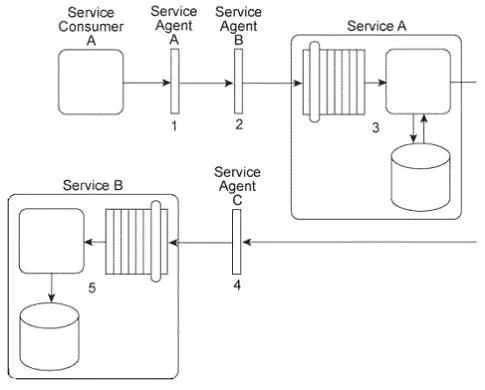
Service Consumer A sends a message to Service A. Before the message arrives with Service A, it is intercepted by Service Agent A (1). which checks the message for compliance to Policy A that is…
Sign in or unlock S90-09A to reveal the answer and full explanation for question #25. The question stem and answer options stay visible for context.
Question
Service Consumer A sends a message to Service A. Before the message arrives with Service A, it is intercepted by Service Agent A (1). which checks the message for compliance to Policy A that is required by Service A. If the message fails compliance, Service Agent A will not allow it to proceed and will instead write the message contents to a log. If the message does comply to the policy, it continues to be transmitted toward Service A, but before it arrives it is intercepted by Service Agent B (2), which validates the security credentials in the message header. If the security credential validation fails, the message is rejected and a runtime exception is raised. If the security credentials are validated, the message is sent to Service A. Upon receiving the message, Service A retrieves a data value from a database and populates the message header with this data value (3) prior to forwarding the message to Service B. Before the message arrives at Service B. it is intercepted by Service Agent C (4) which checks the message for compliance with two policies: Policy B and Policy C. Policy B is identical to Policy A that was checked by Service Agent A. To check for compliance to Policy C. Service Agent C uses the data value added by Service A. If the message complies with both of the policies, it is forwarded to Service B (5), which stores the message contents in its own database. You are told that Policy B and Policy C have changed. Also, in order to carry out the compliance check of Policy C, Service Agent C will now require a new data value from the Service B database. How can this service composition architecture be changed to fulfill these new requirements?
Exhibit
Options
- AThe Policy Centralization pattern can be applied so that only one service agent is used to enforce
- BThe Policy Centralization pattern can be applied so that only one service agent is used to enforce
- CThe Policy Centralization pattern can be applied so that only one service agent is used to enforce
- DNone of the above.
Unlock S90-09A to see the answer
You've previewed enough free S90-09A questions. Unlock S90-09A for full answers, explanations, the timed quiz mode, progress tracking, and the master PDF. Question stem and options stay visible so you can still see what's on the exam.