
S90-09A · Question #11
Our service inventory contains the following three services that provide invoice-related data access capabilities: Invoice, InvProc, and Proclnv. These services were created at different times by…
The correct answer is B. One of the invoice-related services needs to be chosen as the official service providing invoice. Option B is correct because fully applying the Official Endpoint pattern requires more than just selecting one of the three invoice services as authoritative and redirecting Service Consumers A, B, and C to it - it also requires eliminating Service Consumer D's direct database…
Question
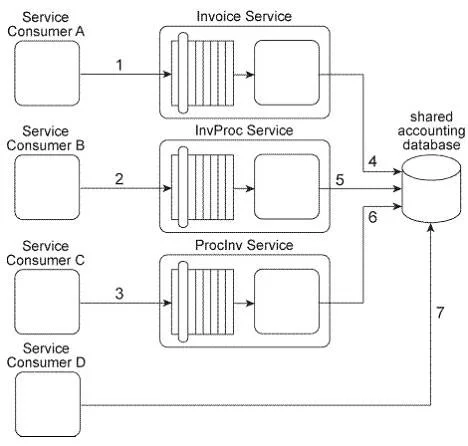
Our service inventory contains the following three services that provide invoice-related data access capabilities: Invoice, InvProc, and Proclnv. These services were created at different times by different project teams and were not required to comply to any design standards. Therefore each of these services has a different data model for representing invoice data. Currently each of these three services has one service consumer: Service Consumer A accesses the Invoice service(1). Service Consumer B (2) accesses the InvProc service, and Service Consumer C (3) accesses the Proclnv service. Each service consumer invokes a data access capability of an invoice-related service, requiring that service to interact with the shared accounting database that is used by all invoice-related services (4, 5, 6). Additionally, Service Consumer D was designed to access invoice data from the shared accounting database directly (7), (Within the context of this architecture. Service Consumer D is labeled as a service consumer because it is accessing a resource that is related to the illustrated service architectures.) Assuming that the Invoice service, InvProc service, and ProcInv service are part of the same service inventory, what steps would be required to fully apply the Official Endpoint pattern?
Exhibit
Options
- AOne of the invoice-related services needs to be chosen as the official service providing invoice
- BOne of the invoice-related services needs to be chosen as the official service providing invoice
- CBecause Service Consumers A, B, and C are already carrying out their data access via published
- DNone of the above.
How the community answered
(57 responses)- A5% (3)
- B60% (34)
- C14% (8)
- D21% (12)
Explanation
Option B is correct because fully applying the Official Endpoint pattern requires more than just selecting one of the three invoice services as authoritative and redirecting Service Consumers A, B, and C to it - it also requires eliminating Service Consumer D's direct database access, routing it through the official service instead. The pattern's purpose is to establish a single, governed access point for a resource across an entire service inventory, and direct database access undermines that goal just as much as redundant services do.
Option A is incomplete because it likely stops at consolidating the three services and migrating A, B, and C, but overlooks D's direct coupling to the shared accounting database. Option C is incorrect because the fact that A, B, and C already use some service endpoint does not satisfy the pattern - those endpoints have inconsistent data models and there are three of them, not one official one; the pattern demands standardization and consolidation. Option D fails because a correct answer does exist.
Memory tip: Think of "Official Endpoint" as plugging all leaks - every consumer, including those going around the services entirely (like direct DB access), must be funneled through the single official service. If even one consumer bypasses it, the pattern is only partially applied.
Topics
Community Discussion
No community discussion yet for this question.