
S90-09A · Question #7
Service A is a task service that is required to carry out a series of updates to a set of databases in order to complete a task. To perform the database updates Service A must interact with three…
Sign in or unlock S90-09A to reveal the answer and full explanation for question #7. The question stem and answer options stay visible for context.
Question
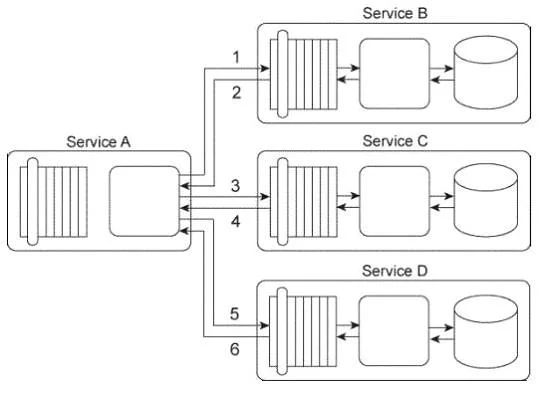
Service A is a task service that is required to carry out a series of updates to a set of databases in order to complete a task. To perform the database updates Service A must interact with three other services, each of which provides standardized data access capabilities. Service A sends its first update request message to Service B (1), which then responds with a message containing a success or failure code (2). Service A then sends its second update request message to Service C (3), which also responds with a message containing a success or failure code (4). Finally, Service A sends a request message to Service D (5), which responds with its own message containing a success or failure code (6). You've been given a requirement that all database updates must either be completed successfully or not at all. This means that if any of the three response messages received by Service A contain a failure code, all of the updates carried out until that point must be reversed. Note that if Service A does not receive a response message back from Services B, C, or D, it must assume that a failure has occurred. How can this service composition architecture be changed to fulfill these requirements?
Exhibit
Options
- AThe Reliable Messaging pattern can be applied to guarantee the delivery of positive or negative
- BThe Atomic Service Transaction pattern can be applied individually to Services B, C, and D so that
- CThe Compensating Service Transaction can be applied to Service A so that when any one
- DNone of the above.
Unlock S90-09A to see the answer
You've previewed enough free S90-09A questions. Unlock S90-09A for full answers, explanations, the timed quiz mode, progress tracking, and the master PDF. Question stem and options stay visible so you can still see what's on the exam.