
S90-09A · Question #8
Service A is a task service that is required to carry out a series of updates to a set of databases in order to complete a task. To perform the database updates Service A must interact with three…
Sign in or unlock S90-09A to reveal the answer and full explanation for question #8. The question stem and answer options stay visible for context.
Question
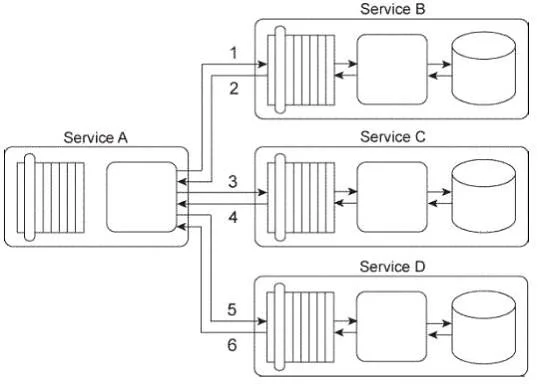
Service A is a task service that is required to carry out a series of updates to a set of databases in order to complete a task. To perform the database updates Service A must interact with three other services, each of which provides standardized data access capabilities. Service A sends its first update request message to Service B (1), which then responds with a message containing a success or failure code (2). Service A then sends its second update request message to Service C (3), which also responds with a message containing a success or failure code (4). Finally, Service A sends a request message to Service D (5), which responds with its own message containing a success or failure code (6). You've been asked to change this service composition architecture in order to fulfill a set of new requirements: First, if the database update performed by Service B fails, then it must be logged by Service A. Secondly, if the database update performed by Service C fails, then a notification e- mail must be sent out to a human administrator. Third, if the database update performed by either Service C or Service D fails, then both of these updates must be reversed so that the respective databases are restored back to their original states. What steps can be taken to fulfill these requirements?
Exhibit
Options
- AService A is updated to perform a logging routine when Service A receives a response message
- BThe Compensating Service Transaction pattern is applied to Service B so that it invokes exception
- CThe Atomic Service Transaction pattern is applied so that Services A, C, and D are encompassed
- DNone of the above.
Unlock S90-09A to see the answer
You've previewed enough free S90-09A questions. Unlock S90-09A for full answers, explanations, the timed quiz mode, progress tracking, and the master PDF. Question stem and options stay visible so you can still see what's on the exam.