
S90-09A · Question #17
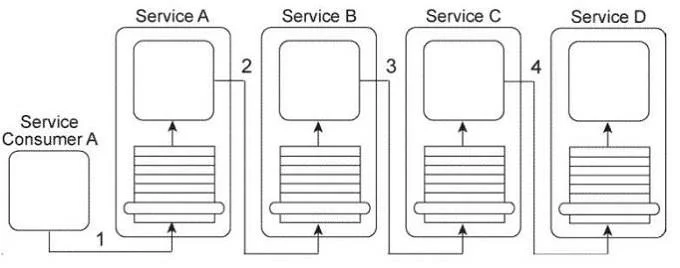
Service Consumer A sends a message to Service A (1), which then forwards the message to Service B (2). Service B forwards the message to Service C (3), which finally forwards the message to Service…
Sign in or unlock S90-09A to reveal the answer and full explanation for question #17. The question stem and answer options stay visible for context.
Question
Service Consumer A sends a message to Service A (1), which then forwards the message to Service B (2). Service B forwards the message to Service C (3), which finally forwards the message to Service D (4). Services A, B, and C each contain logic that reads the content of the message and, based on this content, determines which service to forward the message to. As a result, what is shown in the Figure is one of several possible runtime scenarios. You are told that the current service composition architecture is having performance problems because of two specific reasons. First, too many services need to be explicitly invoked in order for the message to arrive at its destination. Secondly, because each of the intermediary services is required to read the entire message contents in order to determine where to forward the message to, it is taking too long for the overall task to complete. What steps can be taken to solve these problems without sacrificing any of the functionality that currently exists?
Exhibit
Options
- AThe Intermediate Routing pattern can be applied together with the Service Agent pattern in order
- BThe Intermediate Routing pattern can be applied together with the Service Agent pattern in order
- CThe Intermediate Routing pattern can be applied together with the Service Agent pattern in order
- DNone of the above.
Unlock S90-09A to see the answer
You've previewed enough free S90-09A questions. Unlock S90-09A for full answers, explanations, the timed quiz mode, progress tracking, and the master PDF. Question stem and options stay visible so you can still see what's on the exam.