
SOA
S90-09A · Question #15
S90-09A Question #15: Real Exam Question with Answer & Explanation
Sign in or unlock S90-09A to reveal the answer and full explanation for question #15. The question stem and answer options stay visible for context.
Question
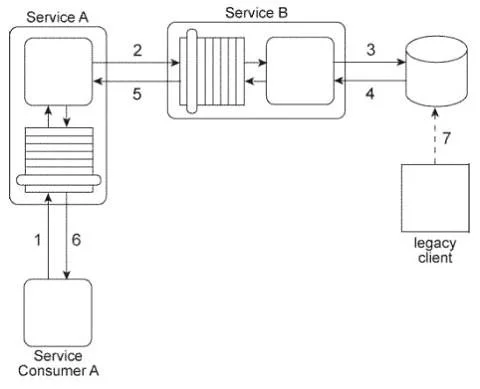
Service A is an entity service that provides a Get capability that returns a data value that is frequently changed. Service Consumer A invokes Service A in order to request this data value (1). For Service A to carry out this request, it must invoke Service B (2), a utility service that interacts (3.4) with the database in which the data value is stored. Regardless of whether the data value changed, Service B returns the latest value to Service A (5), and Service A returns the latest value to Service Consumer A (6). The data value is changed when the legacy client program updates the database (7) When this change happens is not predictable. Note also that Service A and Service B are not always available at the same time. Any time the data value changes. Service Consumer A needs to receive it as soon as possible. Therefore, Service Consumer A initiates the message exchange shown in the Figure several times a day. When it receives the same data value as before, the response from Service A is ignored. When Service A provides an updated data value, Service Consumer A can process it to carry out its task. The current service composition architecture is using up too many resources due to the repeated invocation of Service A by Service Consumer A and the resulting message exchanges that occur with each invocation. What steps can be taken to solve this problem?
Exhibit
Options
- AThe Event-Driven Messaging pattern can be applied by establishing a subscriber-publisher
- BThe Event-Driven Messaging pattern can be applied by establishing a subscriber-publisher
- CThe Asynchronous Queuing pattern can be applied so that messaging queues are established
- DNone of the above.
Unlock S90-09A to see the answer
You've previewed enough free S90-09A questions. Unlock S90-09A for full answers, explanations, the timed quiz mode, progress tracking, and the master PDF. Question stem and options stay visible so you can still see what's on the exam.