
S90-09A · Question #14
Service A is an entity service that provides a set of generic and reusable service capabilities. In order to carry out the functionality of any one of its service capabilities, Service A is required…
Sign in or unlock S90-09A to reveal the answer and full explanation for question #14. The question stem and answer options stay visible for context.
Question
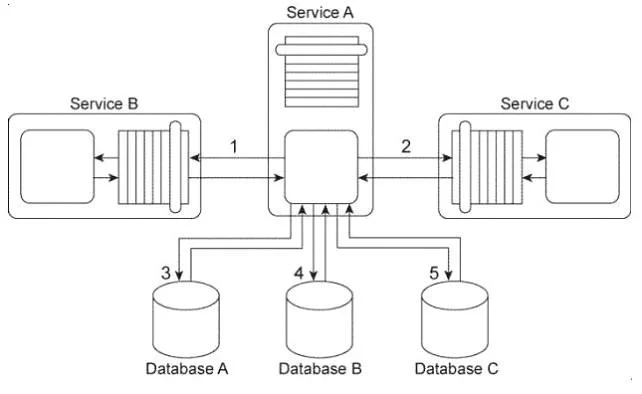
Service A is an entity service that provides a set of generic and reusable service capabilities. In order to carry out the functionality of any one of its service capabilities, Service A is required to compose Service B (1) and Service C (2) and Service A is required to access Database A (3), Database B (4), and Database C (5). These three databases are shared by other applications within the IT enterprise. All of service capabilities provided by Service A are synchronous, which means that for each request a service consumer makes. Service A is required to issue a response message after all of the processing has completed. Depending on the nature of the service consumer request, Service A may be required to hold data it receives in memory until its underlying processing completes. This includes data it may receive from either Service A or Service B or from any of the three shared databases. Service A is one of many entity services that reside in a highly normalized service inventory. Because Service A provides agnostic logic, it is heavily reused and is currently part of many service compositions. You are told that Service A has recently become unstable and unreliable. The problem has been traced to two issues with the current service architecture. First, Service B, which is also an entity service, is being increasingly reused and has itself become unstable and unreliable. When Service B fails, the failure is carried over to Service A . Secondly, shared Database B has a complex data model. Some of the queries issued by Service A to shared Database B can take a very long time to complete. What steps can be taken to solve these problems without compromising the normalization of the service inventory?
Exhibit
Options
- AThe Redundant Implementation pattern can be applied to Service A, thereby making duplicate
- BThe Redundant Implementation pattern can be applied to Service B, thereby making duplicate
- CThe Redundant Implementation pattern can be applied to Service B, thereby making duplicate
- DNone of the above.
Unlock S90-09A to see the answer
You've previewed enough free S90-09A questions. Unlock S90-09A for full answers, explanations, the timed quiz mode, progress tracking, and the master PDF. Question stem and options stay visible so you can still see what's on the exam.