
S90-09A · Question #31
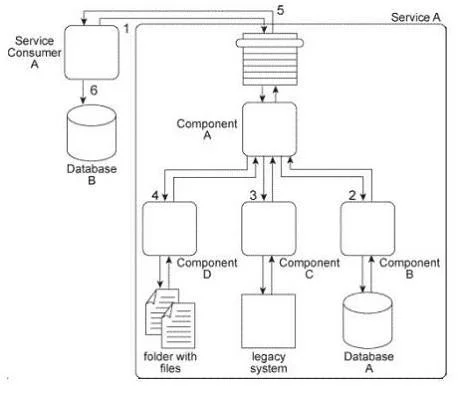
When Service A receives a message from Service Consumer A(1),the message is processed by Component A. This component first invokes Component B (2), which uses values from the message to query…
Sign in or unlock S90-09A to reveal the answer and full explanation for question #31. The question stem and answer options stay visible for context.
Question
When Service A receives a message from Service Consumer A(1),the message is processed by Component A. This component first invokes Component B (2), which uses values from the message to query Database A in order to retrieve additional data. Component B then returns the additional data to Component A. Component A then invokes Component C (3), which interacts with the API of a legacy system to retrieve a new data value. Component C then returns the data value back to Component A. Next, Component A sends some of the data it has accumulated to Component D (4), which writes the data to a text file that is placed in a specific folder. Component D then waits until this file is imported into a different system via a regularly scheduled batch import. Upon completion of the import, Component D returns a success or failure code back to Component A. Component A finally sends a response to Service Consumer A (5) containing all of the data collected so far and Service Consumer A writes all of the data to Database B (6). Components A, B, C. and D belong to the Service A service architecture. Database A, the legacy system, and the file folders are shared resources within the IT enterprise. Service A is a task service that completes an entire business task on its own without having to compose other services. However, you have received many complaints about the reliability of Service A . Specifically, it has three problems. First, when Component B accesses Database A, it may not receive a response for several minutes when the database is being accessed by other applications in the IT enterprise. Secondly, the legacy system accessed by Component C frequently crashes and therefore becomes unavailable for extended periods of time. Third, for Component D to respond to Component A, it must first wait for the batch import of the files to occur. This can take several minutes during which Service Consumer A remains stateful and consumes excessive memory. What steps can be taken to address these three problems?
Exhibit
Options
- AThe Legacy Wrapper pattern can be applied so that Component B is separated to wrap the shared
- BThe Service Data Replication pattern can be applied so that Component B can access a replicated
- CThe interaction between Service Consumer A and Component A is then redesigned so that
- DThe Service Data Replication pattern can be applied so that Component B can access a replicated
- ENone of the above.
Unlock S90-09A to see the answer
You've previewed enough free S90-09A questions. Unlock S90-09A for full answers, explanations, the timed quiz mode, progress tracking, and the master PDF. Question stem and options stay visible so you can still see what's on the exam.