
S90-09A · Question #27
Service Consumer A sends a message to Service A. There are currently three duplicate implementations of Service A (Implementation 1, Implementation 2, Implementation 3). The message sent by Service…
The correct answer is B. The Service Autonomy principle is applied to further isolate the individual implementations of. Service Autonomy means a service maintains high control over its dedicated execution environment - but here, all three implementations share the same physical server, meaning they compete for the same CPU, memory, and I/O resources. Distributing the implementations across…
Question
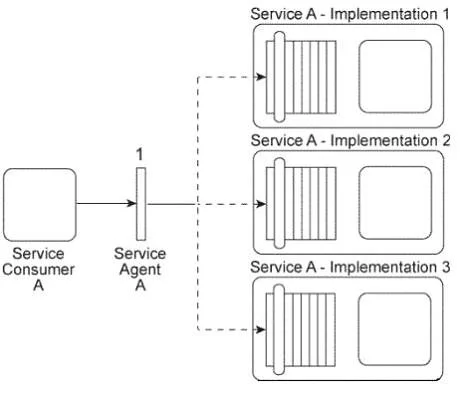
Service Consumer A sends a message to Service A. There are currently three duplicate implementations of Service A (Implementation 1, Implementation 2, Implementation 3). The message sent by Service Consumer A is intercepted by Service Agent A (1), which determines at runtime which implementation of Service A to forward the message to. All three implementations of Service A reside on the same physical server. You are told that despite the fact that duplicate implementations of Service A exist, performance is still poor at times. Also, you are informed that a new service capability will soon need to be added to Service A that will introduce functionality that will require access to a shared database that is used by many other clients and applications in the IT enterprise. This is expected to add further performance demands on Service A . How can this service architecture be changed to improve performance in preparation for the addition of the new service capability?
Exhibit
Options
- AThe Standardized Service Contract principle is applied to ensure that the new service capability
- BThe Service Autonomy principle is applied to further isolate the individual implementations of
- CThe Service Loose Coupling principle is applied together with the Standardized Service Contract
How the community answered
(35 responses)- A40% (14)
- B43% (15)
- C17% (6)
Explanation
Service Autonomy means a service maintains high control over its dedicated execution environment - but here, all three implementations share the same physical server, meaning they compete for the same CPU, memory, and I/O resources. Distributing the implementations across separate physical servers (applying Autonomy) gives each instance dedicated resources, directly addressing the performance bottleneck and preparing for the additional database load the new capability will introduce.
Option A is wrong because Standardized Service Contract governs how a service's interface is defined and communicated - it has no bearing on runtime performance or resource allocation. Option C is wrong because Loose Coupling reduces dependency between a service and its consumers, but the problem is not tight coupling - it's resource contention caused by co-locating all implementations on the same hardware; decoupling the interface won't free up server capacity.
Memory tip: When a question describes multiple service instances that still perform poorly, look for the answer that addresses physical resource isolation, not interface design (Contract) or dependency management (Loose Coupling) - that's the signature of Autonomy.
Topics
Community Discussion
No community discussion yet for this question.