
352-001 · Question #540
Refer to the exhibit. You must review this single OSPF area, DMVPN network because the company has noticed a few area 0 convergence and stability issues. Also, traffic destined to the data center…
The correct answer is C. Modify OSPF cost metrics on all backup links. In a single-area OSPF DMVPN network where equal-cost backup links cause a spoke to appear as the optimal next hop to the data center, raising the OSPF cost on backup links is the minimal change that forces traffic onto the direct hub path.
Question
Refer to the exhibit. You must review this single OSPF area, DMVPN network because the company has noticed a few area 0 convergence and stability issues. Also, traffic destined to the data center from one of the spokes as the next hop on the path. The company prefers that all traffic destined to the data center uses the least amount of hops. Which solution resolves these issues with the minimum amount of changes on the network?
Exhibit
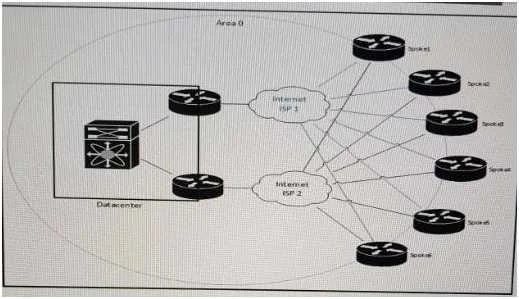
Options
- AMigrate from OSPF to static routes between the hub routers and the spoke routers and deploy IP
- BMigrate from OSPF to EIGRP between the hub routers and the spoke routers
- CModify OSPF cost metrics on all backup links
- DCreate areas between each hub and their spoke routers, to ensure that the hub routers become
How the community answered
(50 responses)- A18% (9)
- B8% (4)
- C44% (22)
- D30% (15)
Why each option
In a single-area OSPF DMVPN network where equal-cost backup links cause a spoke to appear as the optimal next hop to the data center, raising the OSPF cost on backup links is the minimal change that forces traffic onto the direct hub path.
Replacing OSPF with static routes and IP SLA requires authoring and tracking individual static entries on every hub and spoke router across the network, which is a large-scale configuration effort that contradicts the minimum-changes requirement.
Migrating from OSPF to EIGRP requires removing and replacing the routing protocol configuration on every router in the DMVPN topology, making it the highest-impact change possible and not a minimum-change solution.
When backup links share equal OSPF cost with primary hub links, OSPF may install a path through a spoke router as an equal-cost or even preferred route toward the data center, causing suboptimal forwarding and contributing to area 0 instability from frequent metric-equal path oscillations. Increasing the OSPF cost specifically on backup links makes the direct hub-to-data-center path definitively preferred, eliminates the spoke-as-next-hop condition, and reduces SPF-triggered instability - all with changes limited to interface cost values on existing configuration.
Introducing new OSPF areas between each hub and its spokes requires redesigning the area topology and reconfiguring ABR functionality on hub routers, representing extensive changes across the network rather than a minimal fix.
Concept tested: OSPF cost tuning to enforce optimal paths in DMVPN
Source: https://www.cisco.com/c/en/us/td/docs/solutions/Enterprise/WAN_and_MAN/DMVPN_2_Phase2/DMVPN_Phase2.html
Topics
Community Discussion
No community discussion yet for this question.