
352-001 · Question #38
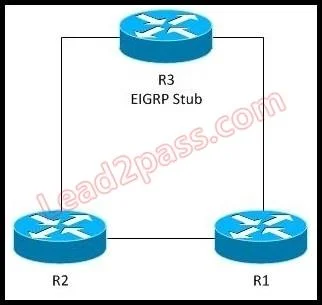
Refer to the exhibit. This diagram depicts the design of a small network that will run EIGRP on R1 and R2, and EIGRP Stub on R3. In which two ways will this network be impacted if there is link…
The correct answer is B. R3 will have routes in its routing table that originate from R1 and R2. E. R3 will not be transit for traffic between R1 and R2. EIGRP Stub prevents R3 from being queried during reconvergence and from acting as a transit router, but R3 still receives full routing updates from its upstream neighbors R1 and R2.
Question
Refer to the exhibit. This diagram depicts the design of a small network that will run EIGRP on R1 and R2, and EIGRP Stub on R3. In which two ways will this network be impacted if there is link instability between R1 and R2? (Choose two.)
Exhibit
Options
- AR1 will have routes in its routing table that originate from R2 and R3.
- BR3 will have routes in its routing table that originate from R1 and R2.
- CR2 will have routes in its routing table that originate from R1 and R3.
- DR3 will be transit for traffic between R1 and R2.
- ER3 will not be transit for traffic between R1 and R2.
How the community answered
(27 responses)- A11% (3)
- B63% (17)
- C4% (1)
- D22% (6)
Why each option
EIGRP Stub prevents R3 from being queried during reconvergence and from acting as a transit router, but R3 still receives full routing updates from its upstream neighbors R1 and R2.
This assumes R1 maintains stable, full routes from R2 and R3 during link instability between R1 and R2, but the instability itself means R1 may lose or fluctuate routes from R2, making this an unreliable statement.
A stub router still receives all routing updates from its upstream non-stub peers; EIGRP Stub only restricts what routes R3 advertises and prevents R3 from being queried during reconvergence, so R3's routing table still contains routes originating from both R1 and R2.
Like option A, this assumes R2 will have consistent routes from R1 and R3 during active link instability between R1 and R2, which cannot be guaranteed during a flapping event.
EIGRP Stub routing explicitly prevents R3 from being used as a transit router, so this is the direct opposite of the correct behavior defined by the stub feature.
EIGRP Stub explicitly marks R3 as a dead-end router, causing R1 and R2 to never use R3 as a transit path between them; non-stub peers will not forward traffic through a stub router, which is the primary design intent of EIGRP Stub.
Concept tested: EIGRP Stub routing transit prevention behavior
Source: https://www.cisco.com/c/en/us/support/docs/ip/enhanced-interior-gateway-routing-protocol-eigrp/110851-eigrp-stub-toc.html
Topics
Community Discussion
No community discussion yet for this question.