
352-001 · Question #672
Refer to the exhibit. Why is a route leaking mechanism needed in this large, unified MPLS network with end-to-end BGP labeled prefixes and IS-IS multilevel areas as the IGP?
The correct answer is D. to announce PE loopbacks fromother IS-IS areas into the Layer 2 backbone area. In IS-IS multilevel networks, PE loopback addresses in Level 1 areas are not automatically visible to the Level 2 backbone, requiring route leaking to enable end-to-end BGP labeled path reachability.
Question
Refer to the exhibit. Why is a route leaking mechanism needed in this large, unified MPLS network with end-to-end BGP labeled prefixes and IS-IS multilevel areas as the IGP?
Exhibit
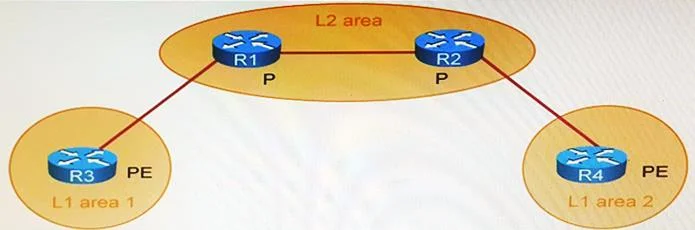
Options
- Afor PE management such as Telnet or SNMP
- Bto leak routes from the Layer 2 backbone to the Layer 1 areas
- Cto build an LSP between the PE routers
- Dto announce PE loopbacks fromother IS-IS areas into the Layer 2 backbone area
How the community answered
(43 responses)- A35% (15)
- B7% (3)
- C16% (7)
- D42% (18)
Why each option
In IS-IS multilevel networks, PE loopback addresses in Level 1 areas are not automatically visible to the Level 2 backbone, requiring route leaking to enable end-to-end BGP labeled path reachability.
PE management access via Telnet or SNMP does not require IS-IS route leaking; management reachability is handled through out-of-band networks or default routes.
Route leaking in IS-IS flows from Level 1 areas up into the Level 2 backbone, not from the backbone down to Level 1 areas, which is the reverse of what this option states.
LSPs are built by the label distribution protocol (LDP or RSVP-TE) based on IGP reachability; route leaking is a prerequisite for that IGP reachability, not a direct mechanism for building LSPs.
In IS-IS, Level 1 routers only have visibility within their own area and do not advertise prefixes into the Level 2 backbone by default. PE loopbacks residing in L1 areas must be explicitly leaked into the L2 backbone so that all PEs can resolve BGP next-hops and establish end-to-end label-switched paths across the unified MPLS network.
Concept tested: IS-IS multilevel route leaking for MPLS PE reachability
Source: https://www.cisco.com/c/en/us/td/docs/ios-xml/ios/iproute_isis/configuration/xe-16/iri-xe-16-book/iri-overview.html
Topics
Community Discussion
No community discussion yet for this question.