
352-001 · Question #253
Refer to the exhibit. A service provider using IS-IS has designed this network with all core links at the Layer 2 control plane. How will they adjust the design to reduce the flooding of update…
The correct answer is C. Use IS-IS mesh groups. IS-IS mesh groups reduce unnecessary LSP flooding in fully meshed topologies by restricting which interfaces retransmit received LSPs, eliminating redundant floods across a dense core.
Question
Refer to the exhibit. A service provider using IS-IS has designed this network with all core links at the Layer 2 control plane. How will they adjust the design to reduce the flooding of update packets?
Exhibit
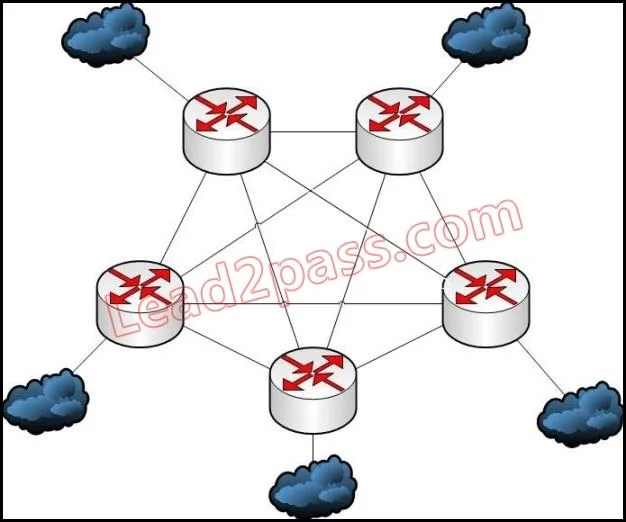
Options
- AChange the area type of the links to be level-1-2 to allow level-1 updates.
- BChange the network type of the links from broadcast to point-to-point.
- CUse IS-IS mesh groups.
- DConfigure SPF timers to be more aggressive so that updates are more quickly cleared from the queue.
How the community answered
(41 responses)- A7% (3)
- B15% (6)
- C73% (30)
- D5% (2)
Why each option
IS-IS mesh groups reduce unnecessary LSP flooding in fully meshed topologies by restricting which interfaces retransmit received LSPs, eliminating redundant floods across a dense core.
Changing links from Level 2 to Level 1-2 introduces Level 1 area flooding in addition to Level 2 flooding, which increases LSP update traffic rather than reducing it.
Changing the network type from broadcast to point-to-point eliminates the DIS election and pseudonode LSPs but does not address the core problem of redundant LSP retransmission across many interfaces in a mesh.
IS-IS mesh groups assign interfaces to a numbered group so that an LSP received on one interface in the group is not retransmitted out other interfaces in the same group. In a fully meshed core where every router already receives each LSP via multiple paths, this suppresses the redundant retransmissions that dense topologies naturally generate. The result is a direct and significant reduction in the volume of flooding update packets without altering the topology or routing behavior.
Aggressive SPF timers control how quickly the shortest-path-first calculation runs after an LSP is received - they affect computation scheduling, not the volume or propagation of LSP flood packets across the network.
Concept tested: IS-IS mesh groups reducing LSP flooding in dense topologies
Source: https://www.cisco.com/c/en/us/td/docs/ios-xml/ios/iproute_isis/configuration/xe-16/irs-xe-16-book/irs-mesh-grp.html
Topics
Community Discussion
No community discussion yet for this question.