
352-001 · Question #647
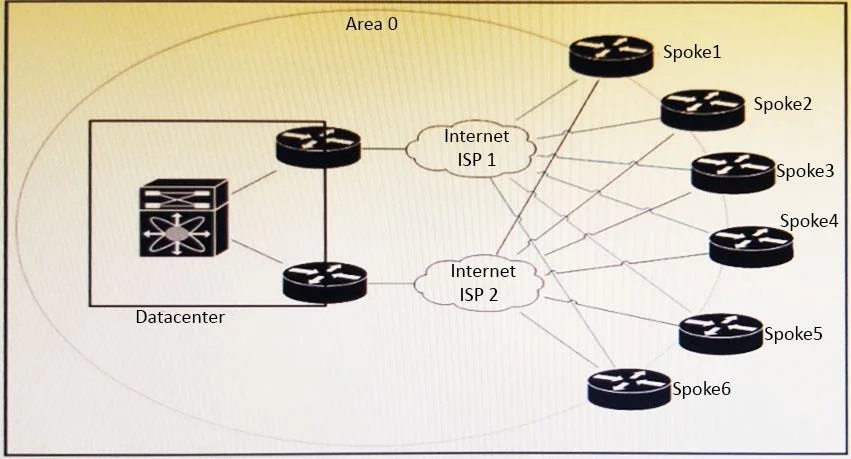
Refer to the exhibit. This DMVPN network is running OSPF in a single area. A network engineer notices that traffic destined to the data center from one of the spokes is using another spoke as the…
The correct answer is A. Modify OSPF cost metrics on all backup links. In a DMVPN single-area OSPF design, suboptimal spoke-to-spoke routing toward the data center is best corrected by tuning OSPF cost metrics to prefer the hub path, requiring the fewest changes.
Question
Refer to the exhibit. This DMVPN network is running OSPF in a single area. A network engineer notices that traffic destined to the data center from one of the spokes is using another spoke as the next hop. It is preferred that all traffic destined to the data center uses the least amount of hops. Which solution resolves this issue with the minimum amount of changes on the network?
Exhibit
Options
- AModify OSPF cost metrics on all backup links
- BMigrate from OSPF to static routes between the hub routers and the spoke routers and deploy IP
- CCreate areas between each hub and their spoke routers, to ensure that the hub routers become
- DMigrate from OSPF to EIGRP between the hub routers and the spoke routers
How the community answered
(49 responses)- A65% (32)
- B4% (2)
- C20% (10)
- D10% (5)
Why each option
In a DMVPN single-area OSPF design, suboptimal spoke-to-spoke routing toward the data center is best corrected by tuning OSPF cost metrics to prefer the hub path, requiring the fewest changes.
Increasing the OSPF interface cost on spoke or backup links makes the direct hub-to-data-center path the lowest-cost route, steering traffic away from spoke-to-spoke paths. This requires modifying only a small number of interface metric values rather than redesigning protocols or topology.
Migrating to static routes with IP SLA requires removing OSPF and manually configuring routes across all devices, which is a large-scale change far exceeding the minimum change requirement.
Introducing additional OSPF areas requires reconfiguring area assignments, ABRs, and route summarization across the entire topology, making it a significantly larger change than a simple metric adjustment.
Replacing OSPF with EIGRP requires a full protocol migration - removing all OSPF configuration and deploying EIGRP on every hub and spoke router - which is not the minimum change.
Concept tested: DMVPN OSPF metric tuning for optimal path selection
Source: https://www.cisco.com/c/en/us/td/docs/ios-xml/ios/iproute_ospf/configuration/xe-16/iro-xe-16-book/iro-cfg.html
Topics
Community Discussion
No community discussion yet for this question.