
352-001 · Question #539
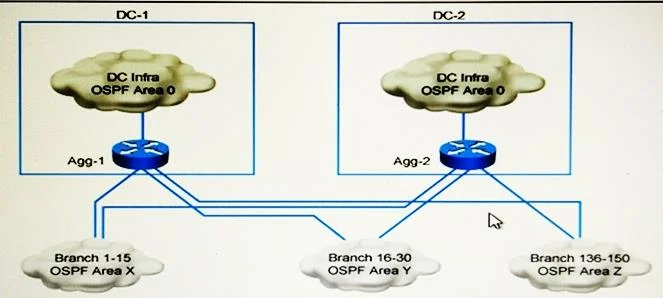
Refer to the exhibit. Company XYZ has 150 branch locations across the U.S. Each branch is connected to two aggregation routers, one router in each data center. The network is configured with…
The correct answer is A. OSPF NSSA. Configuring the branch areas as OSPF NSSAs on the aggregation routers (ABRs) contains external route LSAs within each area as Type 7, preventing them from flooding across the entire multi-area domain and reducing unnecessary SPF recomputation.
Question
Refer to the exhibit. Company XYZ has 150 branch locations across the U.S. Each branch is connected to two aggregation routers, one router in each data center. The network is configured with multiple OSPF areas, and the aggregation routers are ABRs. A requirement is to keep an optimal path to the data centers and, at the same time, reduce the LSA propagation and SPF recomputation during a change in any part of the network. Which design element should be included on the aggregation routers?
Exhibit
Options
- AOSPF NSSA
- Bdistribute lists
- COSPF summarization
- DOSPF totally stubby area
How the community answered
(45 responses)- A44% (20)
- B7% (3)
- C18% (8)
- D31% (14)
Why each option
Configuring the branch areas as OSPF NSSAs on the aggregation routers (ABRs) contains external route LSAs within each area as Type 7, preventing them from flooding across the entire multi-area domain and reducing unnecessary SPF recomputation.
When branch locations redistribute external routes, those routes generate Type 5 LSAs that flood throughout the entire OSPF domain and trigger SPF recalculation on every router. Declaring the branch areas as NSSAs causes external routes to be carried as Type 7 LSAs, which are scoped to the local area; the ABR aggregation routers then selectively convert only summarized Type 7 entries into Type 5 LSAs for the backbone, dramatically reducing LSA flooding domain-wide while still allowing the ABRs to advertise optimal inter-area paths to the data centers.
Distribute lists filter prefixes from being installed in routing tables or redistributed, but they do not reduce the number of LSAs generated or flooded, so SPF recomputation frequency across the domain is unchanged.
OSPF summarization on ABRs reduces the count of Type 3 inter-area LSAs sent into other areas but does not address Type 5 external LSA flooding or the SPF load caused by changes inside the branch areas themselves.
A totally stubby area blocks all Type 3, 4, and 5 LSAs and injects only a default route, which prevents the routers from learning specific paths to each data center and directly violates the optimal-path requirement.
Concept tested: OSPF NSSA to limit external LSA propagation across multi-area design
Source: https://www.cisco.com/c/en/us/support/docs/ip/open-shortest-path-first-ospf/6208-nssa.html
Topics
Community Discussion
No community discussion yet for this question.