
300-510 · Question #240
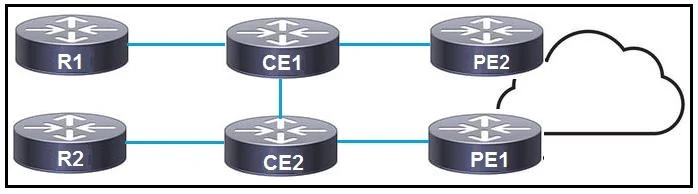
Refer to the exhibit. BGP is running on the network, and CE1 currently prefers routes to the internet via PE1. A network engineer must manipulate the BGP routes that CE1 receives from PE2 to be more…
The correct answer is A. Configure the route map with MED and local preference to manipulate the route outbound. BGP path selection follows a well-defined order of attributes. MED (Multi-Exit Discriminator) is evaluated at step 6 in the decision process, while Local Preference is evaluated at step 2 (after Weight). The engineer made two mistakes: (1) MED is typically used to influence how…
Question
Refer to the exhibit. BGP is running on the network, and CE1 currently prefers routes to the internet via PE1. A network engineer must manipulate the BGP routes that CE1 receives from PE2 to be more desirable. The engineer configured a route map using MED and applied it on CE1 outbound from PE2. However, after a BGP soft reset, PE1 is still preferred. Which action must the engineer take so that PE2 is chosen as the next hop?
Exhibit
Options
- AConfigure the route map with MED and local preference to manipulate the route outbound.
- BConfigure the route map with AS path prepend to manipulate the AS path to exit the autonomous
- CUpdate the route map to use only weight to manipulate the path.
- DApply the route map on CE1 in the inbound direction.
How the community answered
(37 responses)- A68% (25)
- B5% (2)
- C8% (3)
- D19% (7)
Explanation
BGP path selection follows a well-defined order of attributes. MED (Multi-Exit Discriminator) is evaluated at step 6 in the decision process, while Local Preference is evaluated at step 2 (after Weight). The engineer made two mistakes: (1) MED is typically used to influence how an external AS enters YOUR network - it is not the right tool for influencing which exit path CE1 prefers when receiving routes from PE1 and PE2; (2) MED is only compared between routes from the same neighboring AS, so if PE1 and PE2 advertise routes from different contexts, MED values may not even be compared. Local Preference, by contrast, is an iBGP attribute that directly influences path preference within an AS and is evaluated much earlier in the decision process. By adding Local Preference to the route map applied to routes received from PE2, CE1 will prefer those routes over PE1's routes (since higher local preference wins). The route map must be applied inbound on CE1 from PE2 to set local preference on incoming routes - making Option A correct. Options B, C, and D use the wrong attributes or wrong application point.
Topics
Community Discussion
No community discussion yet for this question.