
300-510 · Question #85
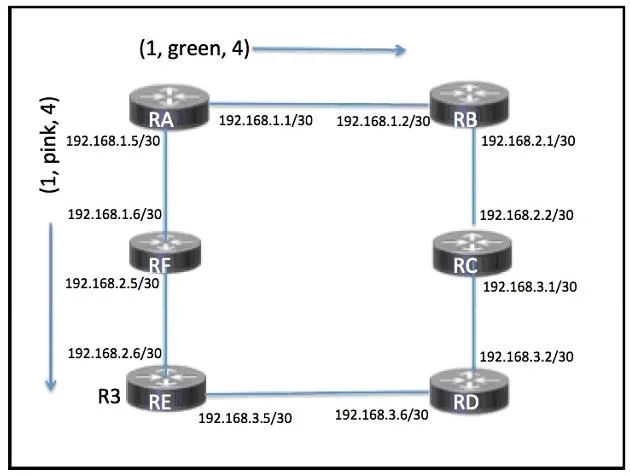
Refer to the exhibit. The green policy is designed with low delay, and the pink policy is designed with low cost. What is the next hop for node A on its way to node D, with the objective of…
The correct answer is D. 192. 168.1.2. This question involves BGP Color-Based traffic engineering (SR-TE policies) or similar policy-based routing where different forwarding paths are selected based on service objectives. The green policy is optimized for low delay, meaning it selects paths with the least latency…
Question
Refer to the exhibit. The green policy is designed with low delay, and the pink policy is designed with low cost. What is the next hop for node A on its way to node D, with the objective of achieving a low delay?
Exhibit
Options
- A192.168.3.2
- B192.168.1.6
- C192.168.3.6
- D
- 168.1.2
How the community answered
(24 responses)- A4% (1)
- B8% (2)
- C17% (4)
- D71% (17)
Explanation
This question involves BGP Color-Based traffic engineering (SR-TE policies) or similar policy-based routing where different forwarding paths are selected based on service objectives. The green policy is optimized for low delay, meaning it selects paths with the least latency, not necessarily the fewest hops or lowest link cost. When node A needs to reach node D using the low-delay (green) policy, it must follow the path dictated by that policy. The next hop 192.168.1.2 represents the first hop along the path that satisfies the low-delay constraint. The other options (192.168.3.2, 192.168.1.6, 192.168.3.6) would be valid hops on the low-cost (pink) path or are not the immediate next hop toward D under the low-delay policy. In SR-TE and traffic engineering scenarios, the forwarding plane follows the policy-imposed path rather than the IGP shortest path, so the correct next hop is determined by which link leads toward the low-delay path to D.
Topics
Community Discussion
No community discussion yet for this question.