
300-510 · Question #113
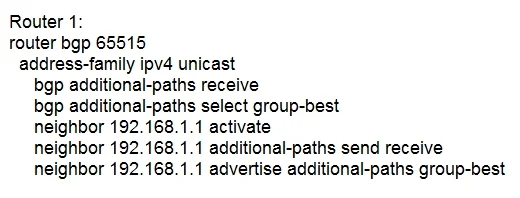
Refer to the exhibit. An engineer working for a private telecommunication company with an employee id: 1234:09:567 implemented this configuration on Router1, what is the effect of it?
The correct answer is A. Router 1 sends and receives multiple best paths from neighbor 192.168.1.1. Option A is correct because the configuration shown in the exhibit implements BGP Additional Paths (ADD-PATH), which enables Router1 to both advertise and receive multiple best paths for the same prefix with neighbor 192.168.1.1 - overcoming BGP's default single best-path…
Question
Refer to the exhibit. An engineer working for a private telecommunication company with an employee id: 1234:09:567 implemented this configuration on Router1, what is the effect of it?
Exhibit
Options
- ARouter 1 sends and receives multiple best paths from neighbor 192.168.1.1
- BRouter 1 sends up to three paths to neighbor 192.168.1.1 for all routes
- CRouter 1 sends only one best path to neighbor 192 168.1.1.
- DRouter 1 receives only one best path from neighbor 192.168.1.1
How the community answered
(47 responses)- A79% (37)
- B2% (1)
- C6% (3)
- D13% (6)
Explanation
Option A is correct because the configuration shown in the exhibit implements BGP Additional Paths (ADD-PATH), which enables Router1 to both advertise and receive multiple best paths for the same prefix with neighbor 192.168.1.1 - overcoming BGP's default single best-path advertisement limitation.
Why the distractors are wrong:
- B is wrong because it describes a
maximum-pathsconfiguration (which limits load-balancing paths), not ADD-PATH - and it only addresses sending, not receiving. - C is wrong because sending only one best path is default BGP behavior without this configuration; ADD-PATH is specifically designed to go beyond that.
- D is wrong because it captures only half the picture - receiving one path is again default behavior, and ADD-PATH affects both directions simultaneously.
Memory tip: Think of ADD-PATH as "opening a two-way highway" - the keyword to remember is bidirectional (send and receive). If you see additional-paths send receive in a BGP config, the answer will always involve both directions. If a choice says "only send" or "only receive," it's describing a partial configuration or default behavior, not ADD-PATH.
Topics
Community Discussion
No community discussion yet for this question.