
300-510 · Question #195
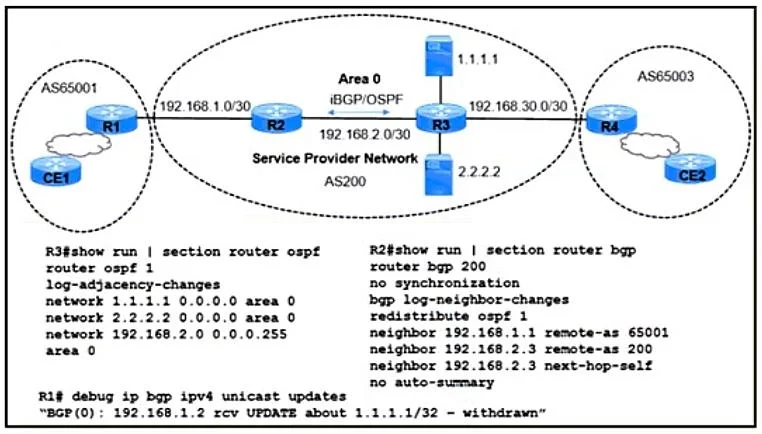
Refer to the exhibit. Users connected to an application on 1.1.1.1 via routers CE1 and CE2 are complaining of frequent disconnections. While troubleshooting the issue, a network engineer with an…
The correct answer is C. Enable route dampening on routers R1 and R2. The root cause is a flapping physical link to the 1.1.1.1 application server. Every time the link flaps, the route to 1.1.1.1 is withdrawn and re-advertised via BGP, causing active TCP sessions from CE1 and CE2 users to be torn down and re-established - resulting in the…
Question
Refer to the exhibit. Users connected to an application on 1.1.1.1 via routers CE1 and CE2 are complaining of frequent disconnections. While troubleshooting the issue, a network engineer with an employee ID: 1234:56:789 determined that the application itself is working normally, but the link connected to the 1.1.1.1 application is flapping. The users on CE1 and CE2 are accessing applications on 2.2.2.2 without difficulty. Which action resolves the issue?
Exhibit
Options
- AEnable passive interface on the router R3 Loopback1 interface.
- BDisable split horizon on router R2.
- CEnable route dampening on routers R1 and R2.
- DRedistribute CE1 routes on router R2.
How the community answered
(37 responses)- A3% (1)
- B8% (3)
- C73% (27)
- D16% (6)
Explanation
The root cause is a flapping physical link to the 1.1.1.1 application server. Every time the link flaps, the route to 1.1.1.1 is withdrawn and re-advertised via BGP, causing active TCP sessions from CE1 and CE2 users to be torn down and re-established - resulting in the experienced disconnections. BGP route dampening addresses this by assigning a penalty each time a route flaps; when the accumulated penalty exceeds a suppress threshold, the route is suppressed (withheld from advertisement) until it stabilizes and the penalty decays below a reuse threshold. Enabling dampening on R1 and R2 prevents the unstable route from being repeatedly advertised and withdrawn, stabilizing connectivity for users. Option A (passive interface on loopback) does not address link flapping. Option B (disabling split horizon on R2) is unrelated to this scenario. Option D (redistributing CE1 routes on R2) does not solve the flapping issue. Route dampening on R1 and R2 is the correct mechanism to mitigate the impact of the flapping link.
Topics
Community Discussion
No community discussion yet for this question.