
300-510 · Question #150
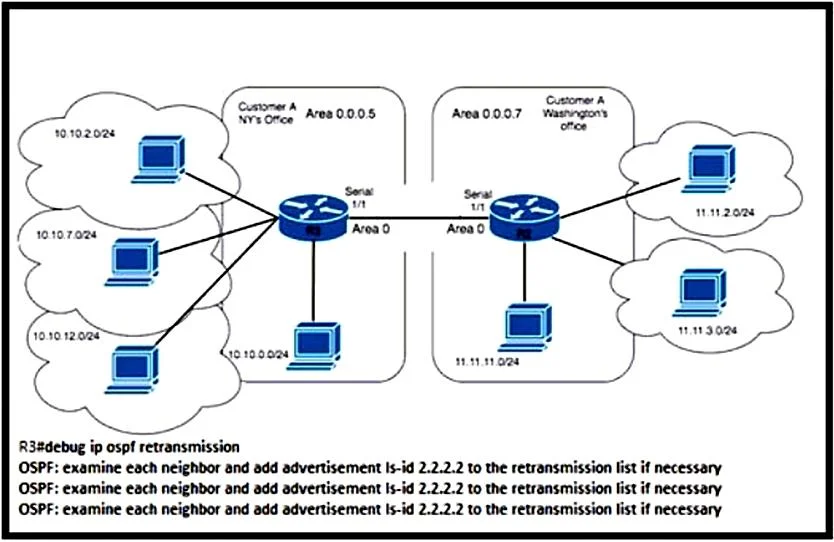
Refer to the exhibit. Customer A is a small media company with two offices connected by a 512 Kbps tine. Their NY office is connected to several external partners by static routes on router R3. VoIP…
The correct answer is C. Configure the summary-address 10.10.0.0 255.255.240.0 command on R3 to optimize OSPF. Option C is correct because R3 acts as an ASBR (Autonomous System Boundary Router) redistributing multiple static routes to external partners into OSPF. Without summarization, each static route generates a separate Type 5 external LSA, wasting precious bandwidth on the…
Question
Refer to the exhibit. Customer A is a small media company with two offices connected by a 512 Kbps tine. Their NY office is connected to several external partners by static routes on router R3. VoIP services use VoIP codec G729. Users reported poor voice quality and slow data transfer between the offices. A network engineer configured ip tcp header-compression iphc-format on R2 and R3 routers. Which additional action must the engineer lake to fix the issue?
Exhibit
Options
- AConfigure the ip ospf I area O command under Serial 1/1 interfaces on R2 and R3 to avoid
- BChange the OSPF router ID on either router so that the router IDs are unique.
- CConfigure the summary-address 10.10.0.0 255.255.240.0 command on R3 to optimize OSPF
- DConfigure the BGP routing protocol between R2 and R3 to control route propagation.
How the community answered
(53 responses)- A4% (2)
- B11% (6)
- C81% (43)
- D4% (2)
Explanation
Option C is correct because R3 acts as an ASBR (Autonomous System Boundary Router) redistributing multiple static routes to external partners into OSPF. Without summarization, each static route generates a separate Type 5 external LSA, wasting precious bandwidth on the already-congested 512 Kbps link. The summary-address 10.10.0.0 255.255.240.0 command on R3 aggregates those external routes into a single LSA, freeing bandwidth for VoIP and data-directly addressing the reported symptoms.
Why the distractors fail:
- A - Adding interfaces to OSPF area 0 doesn't reduce routing overhead or improve bandwidth utilization; it may actually increase LSA flooding.
- B - Duplicate router IDs would cause full adjacency or routing failures, not merely "poor quality"-and no conflict is described in the scenario.
- D - BGP is designed for inter-AS routing between large autonomous systems, not a two-office SMB; it adds complexity without solving the bandwidth problem.
Memory tip: Think "ASBR summarizes, bandwidth materializes." Whenever you see an ASBR redistributing static/external routes over a slow WAN, route summarization (via summary-address) is the OSPF tool that converts many LSAs into one, recovering link capacity for real traffic.
Topics
Community Discussion
No community discussion yet for this question.