
300-510 · Question #151
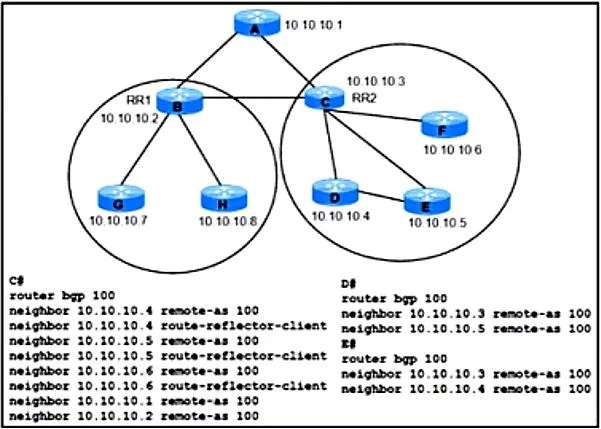
Refer to the exhibit. While troubleshooting a networking issue, an engineer identified a suboptimal communication issue on route reflector RR2. In the current environment: - Router A is a…
The correct answer is B. Enable next-hop-self for BGP peering on router C. Option B is correct because Router C sits between RR2 and its downstream peers, and without next-hop-self, it reflects BGP routes while preserving the original (likely external) next-hop address - an address that RR2's clients cannot resolve, causing suboptimal or broken…
Question
Refer to the exhibit. While troubleshooting a networking issue, an engineer identified a suboptimal communication issue on route reflector RR2. In the current environment:
- Router A is a non-route-reflector client for RR1 and RR2.
- Routers D and E are directly connected iBGP peers.
- Router F is not an iBGP peer of routers D and E.
Which action resolves the issue?
Exhibit
Options
- ADisable BGP Client-to-Client reflection on router RR2.
- BEnable next-hop-self for BGP peering on router C.
- CRemove the route-reflector configuration on router RR2.
- DEnable next-hop-self for BGP peering on router D.
How the community answered
(32 responses)- A13% (4)
- B53% (17)
- C6% (2)
- D28% (9)
Explanation
Option B is correct because Router C sits between RR2 and its downstream peers, and without next-hop-self, it reflects BGP routes while preserving the original (likely external) next-hop address - an address that RR2's clients cannot resolve, causing suboptimal or broken routing. Enabling next-hop-self on Router C forces it to advertise itself as the next-hop, making routes reachable for all downstream iBGP peers.
Why the distractors fail:
- A - Disabling client-to-client reflection on RR2 restricts how RR2 reflects routes between clients but does nothing to fix an unreachable next-hop; it would more likely break connectivity than help.
- C - Removing RR2's route-reflector config eliminates its RR role entirely, forcing a full iBGP mesh rebuild - a drastic network redesign, not a targeted fix.
- D - Router D peers directly with E (and not with F), so adding
next-hop-selfon D only affects routes D advertises to its peers, which is a different peering relationship and doesn't address the upstream reflection problem from RR2 through C.
Memory tip: When a BGP route passes through an intermediate router that isn't the original next-hop, ask "can everyone downstream see that next-hop?" If not, next-hop-self is the fix - the intermediate router raises its hand and says "send traffic to me instead."
Topics
Community Discussion
No community discussion yet for this question.