
300-510 · Question #182
Refer to the exhibit. This network is deployed with all connected links configured to run IS-IS. The routing protocol is enabled globally on each router, and the network engineer expects full…
The correct answer is A. Configure all routers to reside in the same area. IS-IS uses a two-level hierarchy: Level 1 (L1) routers share routing information only within their area, and Level 2 (L2) routers share routing information between areas. By default, routers may be configured as L1-only or L2-only. If R1 is in one IS-IS area and R5 is in a…
Question
Refer to the exhibit. This network is deployed with all connected links configured to run IS-IS. The routing protocol is enabled globally on each router, and the network engineer expects full routing information to be shared among all routers. R5 is receiving routes from R4 but is missing routes from R1. Which action corrects the issue so that all routes are shared among the routers?
Exhibit
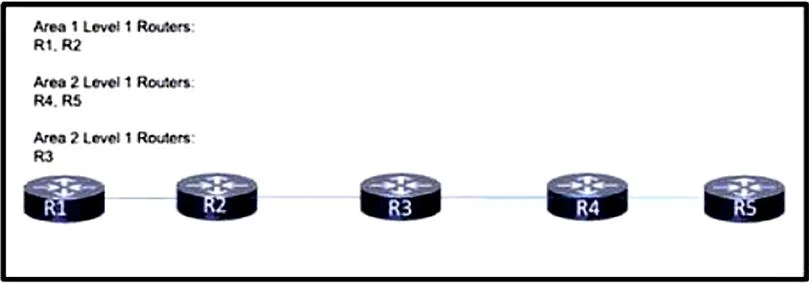
Options
- AConfigure all routers to reside in the same area.
- BConfigure R1 and R5 as Level 1/Level 2 routers.
- CConfigure R3 as a Level 1 /Level 2 router.
- DConfigure R5 in the same area as R1.
How the community answered
(37 responses)- A78% (29)
- B14% (5)
- C5% (2)
- D3% (1)
Explanation
IS-IS uses a two-level hierarchy: Level 1 (L1) routers share routing information only within their area, and Level 2 (L2) routers share routing information between areas. By default, routers may be configured as L1-only or L2-only. If R1 is in one IS-IS area and R5 is in a different area, and there is no L1/L2 (dual-level) router to leak routes between the areas, R5 will not receive routes originated by R1. The cleanest and simplest resolution - without adding the complexity of L1/L2 boundary routers and inter-area route leaking - is to place all routers in the same IS-IS area (typically area 0 or a single flat area). This eliminates the area boundary problem entirely: all routers become L1 or L2 peers within one area and share full routing tables. Option B (making R1 and R5 L1/L2) partially helps but does not fix the problem unless intermediate routers also handle area boundary properly. Option C (making R3 L1/L2) could help if R3 is the boundary router, but may not be sufficient for all missing routes. Option D placing R5 in R1's area without moving other routers may cause a split topology.
Topics
Community Discussion
No community discussion yet for this question.