
300-510 · Question #108
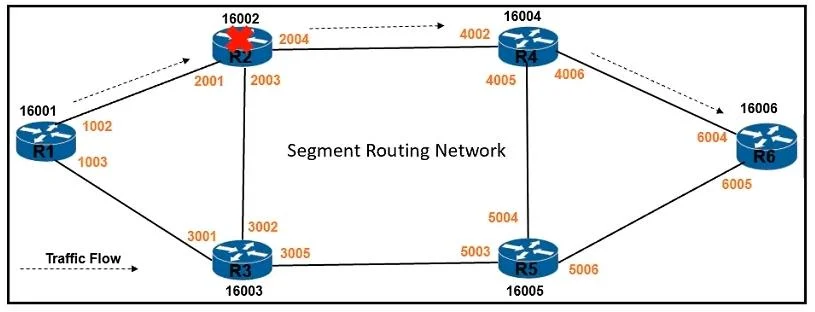
Refer to the exhibit. Traffic flow from router R1 to router R6 is delay-sensitive. It must consider potential link-failure and node-failure conditions. Which configuration must an engineer apply to…
The correct answer is D. R1(config)# router ospf 1 R1(config-router)# area 1 range 192.168.20.0 255.255.252.0 R1(config-router)# area 2 range 192.168.32.0 255.255.252.0. Option D correctly applies /22 (255.255.252.0) masks to both area summarizations: 192.168.20.0/22 precisely covers the subnets in Area 1, and 192.168.32.0/22 precisely covers those in Area 2, giving R1 (as an ABR) accurate summary routes to re-advertise when R2 fails and…
Question
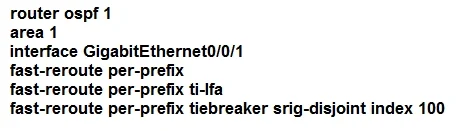
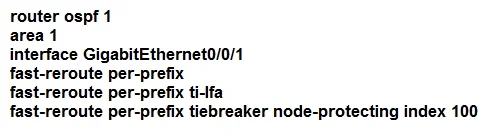
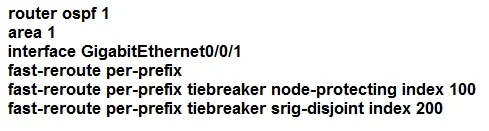
Refer to the exhibit. Traffic flow from router R1 to router R6 is delay-sensitive. It must consider potential link-failure and node-failure conditions. Which configuration must an engineer apply to router R1 to route traffic to router R6 if router R2 fails? A. B. C. D.
Exhibits
Options
- AR1(config)# router ospf 1 R1(config-router)# area 1 range 192.168.20.0 255.255.248.0 R1(config-router)# area 2 range 192.168.32.0 255.255.240.0
- BR1(config)# router ospf 1 R1(config-router)# area 1 range 192.168.20.0 255.255.252.0 R1(config-router)# area 2 range 192.168.32.0 255.255.240.0
- CR1(config)# router ospf 1 R1(config-router)# area 1 range 192.168.20.0 255.255.252.0 R1(config-router)# area 2 range 192.168.32.0 255.255.253.0
- DR1(config)# router ospf 1 R1(config-router)# area 1 range 192.168.20.0 255.255.252.0 R1(config-router)# area 2 range 192.168.32.0 255.255.252.0
How the community answered
(40 responses)- A3% (1)
- B5% (2)
- C10% (4)
- D83% (33)
Explanation
Option D correctly applies /22 (255.255.252.0) masks to both area summarizations: 192.168.20.0/22 precisely covers the subnets in Area 1, and 192.168.32.0/22 precisely covers those in Area 2, giving R1 (as an ABR) accurate summary routes to re-advertise when R2 fails and traffic must take an alternate path to R6.
Why the distractors fail:
- A uses
255.255.248.0(/21) for Area 1 - this is misaligned (192.168.20.0 is not on a /21 boundary; the correct boundary is 192.168.16.0) and also applies an overly broad /20 to Area 2, both causing incorrect or inconsistent routing. - B gets Area 1 right but applies
255.255.240.0(/20) to Area 2, which is far too broad - it would advertise a summary covering 192.168.32.0–192.168.47.255, pulling traffic toward subnets that don't exist and causing black holes. - C gets Area 1 right but uses
255.255.253.0for Area 2, which is an invalid subnet mask - valid masks must be a contiguous block of 1s followed by 0s in binary, and 253 (11111101) breaks that rule entirely.
Memory tip: Think of the two checks as "Real or Fake? Tight or Loose?" - first confirm the mask is a valid contiguous mask (eliminates C), then confirm it's the tightest mask that still covers all required subnets without overshooting (eliminates A and B). Only D passes both checks for both areas.
Topics
Community Discussion
No community discussion yet for this question.