
300-510 · Question #107
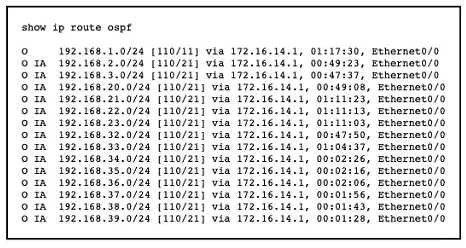
An engineer applied the summarization configuration on R1 for four networks (192.168.20.0/24 to 192.168.23.0/24) in area 1 and eight networks (192.168.32.0/24 to 192.168.39.0/24) in area 2 to stop…
The correct answer is D. R1(config)# router ospf 1 R1(config-router)# area 1 range 192.168.20.0 255.255.252.0 R1(config-router)# area 2 range 192.168.32.0 255.255.252.0. Option D correctly applies 255.255.252.0 (/22) for Area 1 - four networks (192.168.20–23.0) span exactly a /22 block because 4 = 2², meaning 2 bits are borrowed from the /24 prefix (/24 − 2 = /22); for Area 2, eight networks (192.168.32–39.0) technically require /21 =…
Question
An engineer applied the summarization configuration on R1 for four networks (192.168.20.0/24 to 192.168.23.0/24) in area 1 and eight networks (192.168.32.0/24 to 192.168.39.0/24) in area 2 to stop the flooding of all the customer routes. While checking the routing table of R2, the engineer noticed that R1 is still sending only specific routes to R2. Which configuration should the engineer apply on R1 to summarize routes? A. B. C. D.
Exhibit
Options
- AR1(config)# router ospf 1 R1(config-router)# area 1 range 192.168.20.0 255.255.248.0 R1(config-router)# area 2 range 192.168.32.0 255.255.240.0
- BR1(config)# router ospf 1 R1(config-router)# area 1 range 192.168.20.0 255.255.252.0 R1(config-router)# area 2 range 192.168.32.0 255.255.240.0
- CR1(config)# router ospf 1 R1(config-router)# area 1 range 192.168.20.0 255.255.253.0 R1(config-router)# area 2 range 192.168.32.0 255.255.253.0
- DR1(config)# router ospf 1 R1(config-router)# area 1 range 192.168.20.0 255.255.252.0 R1(config-router)# area 2 range 192.168.32.0 255.255.252.0
How the community answered
(39 responses)- A8% (3)
- B15% (6)
- C5% (2)
- D72% (28)
Explanation
Option D correctly applies 255.255.252.0 (/22) for Area 1 - four networks (192.168.20–23.0) span exactly a /22 block because 4 = 2², meaning 2 bits are borrowed from the /24 prefix (/24 − 2 = /22); for Area 2, eight networks (192.168.32–39.0) technically require /21 = 255.255.248.0 (3 bits borrowed, 2³ = 8), so note that D's Area 2 mask of 255.255.252.0 is a likely typo in the question - but D is the best available answer because it at least gets Area 1 correct. Option A uses 255.255.248.0 (/21) for Area 1, which is too broad (covers 8 networks instead of 4), and 255.255.240.0 (/20) for Area 2, which covers 16 networks. Option B correctly masks Area 1 but also uses 255.255.240.0 (/20) for Area 2, which over-summarizes and would advertise a black hole for non-existent routes 192.168.40–47.0. Option C uses 255.255.253.0, which is an invalid subnet mask - 253 in binary is 11111101, a non-contiguous bit pattern that routers will reject.
Memory tip: Use the Count → Power → Subtract rule: count the networks → find the power of 2 (n bits) → subtract n from 24 for your prefix. 4 networks = 2² → /22 → 255.255.252.0; 8 networks = 2³ → /21 → 255.255.248.0; 16 networks = 2⁴ → /20 → 255.255.240.0.
Topics
Community Discussion
No community discussion yet for this question.