
300-510 · Question #106
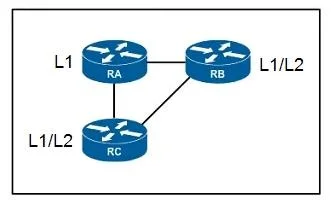
Refer to the exhibit. Routers RA and RB are IS-IS peers configured for NSF but router RC is an IS-IS peer without NSF capability. If RA undergoes processor switchover what is the effect on the…
The correct answer is C. All peer relationships remain up, but the link-state database is rebuilt on each device. Why C is correct: When RA undergoes a processor switchover with NSF configured, the forwarding plane continues operating uninterrupted. RA's IS-IS hellos resume quickly enough (within the hold-timer window) that adjacencies with both RB and RC remain intact - even though RC…
Question
Refer to the exhibit. Routers RA and RB are IS-IS peers configured for NSF but router RC is an IS-IS peer without NSF capability. If RA undergoes processor switchover what is the effect on the network environment?
Exhibit
Options
- AIf RC is operating without the Cisco configuration option all three routers tear down their peering
- BAll peer relationships remain up and the link-state database is unchanged
- CAll peer relationships remain up, but the link-state database is rebuilt on each device
- DIf RC is operating without the Cisco configuration option only 2 routers tear down their peering
How the community answered
(22 responses)- A5% (1)
- B23% (5)
- C64% (14)
- D9% (2)
Explanation
Why C is correct: When RA undergoes a processor switchover with NSF configured, the forwarding plane continues operating uninterrupted. RA's IS-IS hellos resume quickly enough (within the hold-timer window) that adjacencies with both RB and RC remain intact - even though RC lacks NSF capability. However, RA's control plane restarts from scratch, so it loses its link-state database entirely. All three routers must resynchronize the LSDB, meaning it is effectively rebuilt across every device.
Why the distractors fail:
- A is wrong because NSF prevents a full peering teardown - adjacencies do not drop system-wide regardless of the Cisco configuration option on RC.
- B is wrong because the LSDB is not preserved; RA's control plane restart wipes its database, requiring full resynchronization even though no adjacencies went down.
- D is wrong for the same reason as A - no peerings tear down in this scenario, so "2 routers" tearing down is also incorrect.
Memory tip: Use the phrase "NSF = No Session Failure, but New State Flood." The sessions (adjacencies) survive the restart, but the link-state database must be re-flooded and rebuilt because the control plane started fresh.
Topics
Community Discussion
No community discussion yet for this question.