
300-510 · Question #287
Refer to the exhibit. A network engineer at a large ISP with an employee ID 487694052 started to configure OSPF on two routers. The engineer notices that router 1 learned about network 20.20.20.0/24…
The correct answer is A. Replace the router 1 OSPF network configuration with network 10.10.10.0 0.0.0.255 area 0. Router 1 has an incorrect OSPF network statement that prevents it from advertising 10.10.10.0/24 to its neighbor; correcting the wildcard mask and area designation resolves the asymmetric advertisement.
Question
Refer to the exhibit. A network engineer at a large ISP with an employee ID 487694052 started to configure OSPF on two routers. The engineer notices that router 1 learned about network 20.20.20.0/24 from router 2, but router 2 did not learn about 10.10.10.0/24 from router 1 Layer 2 and Layer 3 connectivity are working between the two routers and the physical connection between the devices is functioning. Which action must the engineer take to resolve the issue?
Exhibit
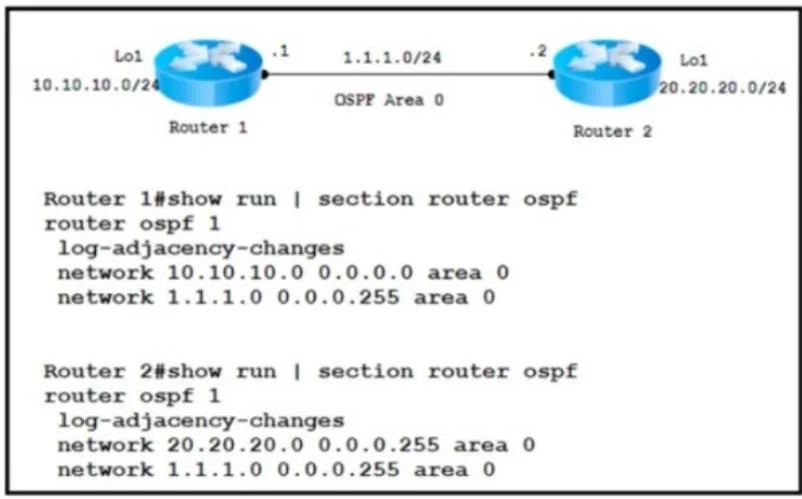
Options
- AReplace the router 1 OSPF network configuration with network 10.10.10.0 0.0.0.255 area 0.
- BOn router 1 configure a route map with a distribution list for the 10 10.10 0/24 network.
- CReplace the router 2 OSPF network configuration with network 10.10.10.0 0.0.0.255 area
- DOn router 2 configure a route map with a distribution list for the 10.10.10.0/24 network
How the community answered
(61 responses)- A89% (54)
- B2% (1)
- C7% (4)
- D3% (2)
Why each option
Router 1 has an incorrect OSPF network statement that prevents it from advertising 10.10.10.0/24 to its neighbor; correcting the wildcard mask and area designation resolves the asymmetric advertisement.
The OSPF network statement on router 1 must be corrected to 'network 10.10.10.0 0.0.0.255 area 0' so that the 10.10.10.0/24 interface is matched and included in OSPF area 0 advertisements. An incorrect wildcard mask or area value in the existing statement causes OSPF to skip that interface entirely, explaining why router 2 never receives the route. Since router 2 is already successfully advertising 20.20.20.0/24, the misconfiguration is isolated to router 1's network statement.
A distribution list with a route map on router 1 is used to filter redistributed external routes, not to fix a missing OSPF network advertisement caused by an incorrect network statement.
The problem resides on router 1 (it is not advertising its network), so modifying router 2's OSPF network statement would not cause router 1 to begin advertising 10.10.10.0/24.
Configuring a distribution list on router 2 would only filter routes received by router 2 and does not address the root cause of router 1 failing to originate the LSA for 10.10.10.0/24.
Concept tested: OSPF network statement wildcard mask misconfiguration
Source: https://www.cisco.com/c/en/us/td/docs/ios-xml/ios/iproute_ospf/configuration/xe-16/iro-ospf-xe-16-book/iro-cfg-ospf.html
Topics
Community Discussion
No community discussion yet for this question.