
300-510 · Question #112
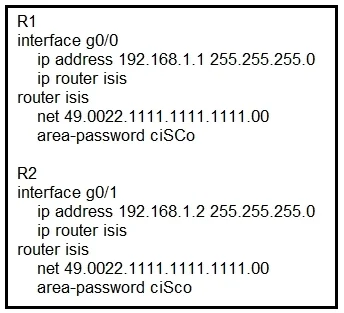
Refer to the exhibit. After these configurations were applied to routers R1 and R2. the two devices cannot form a neighbor relationship. What is the reason tor the problem?
The correct answer is C. The two routers have the same network ID. In IS-IS, each router is identified by a Network Entity Title (NET), which includes the Area ID, the System ID (6-byte unique identifier), and the NSEL byte. The System ID portion of the NET must be globally unique within the IS-IS domain - it functions like a router-level…
Question
Refer to the exhibit. After these configurations were applied to routers R1 and R2. the two devices cannot form a neighbor relationship. What is the reason tor the problem?
Exhibit
Options
- AThe two routers have the same area ID.
- BThe two routers have different IS-types
- CThe two routers have the same network ID
- DThe two routers cannot authenticate with one another
How the community answered
(27 responses)- A4% (1)
- B7% (2)
- C78% (21)
- D11% (3)
Explanation
In IS-IS, each router is identified by a Network Entity Title (NET), which includes the Area ID, the System ID (6-byte unique identifier), and the NSEL byte. The System ID portion of the NET must be globally unique within the IS-IS domain - it functions like a router-level address. If two routers are configured with the same NET (same System ID within the same area), IS-IS cannot distinguish between them and adjacency formation fails. Option A is incorrect because routers in the same area should share the same area ID. Option B (different IS-types) would cause adjacency issues in some cases but is not indicated here. Option D (authentication) would only apply if authentication is configured, which is not shown.
Topics
Community Discussion
No community discussion yet for this question.