
300-510 · Question #241
Refer to the exhibit. OSPF is running in the core of a company. Router RA is running EIGRP. After the company acquired an additional office, an engineering team connected the two networks from…
The correct answer is D. Disable stub routing in Area 1. OSPF stub areas are designed to reduce routing table size by blocking Type 5 LSAs (External LSAs) from entering the area, replacing them with a default route injected by the ABR. When EIGRP routes are redistributed into OSPF on R1, they become Type 5 External LSAs in the OSPF…
Question
Refer to the exhibit. OSPF is running in the core of a company. Router RA is running EIGRP. After the company acquired an additional office, an engineering team connected the two networks from router RA to router R1. OSPF and EIGRP have been mutually redistributed on R1, but the team cannot view the routes on R3. Which action must the team take to resolve the issue?
Exhibit
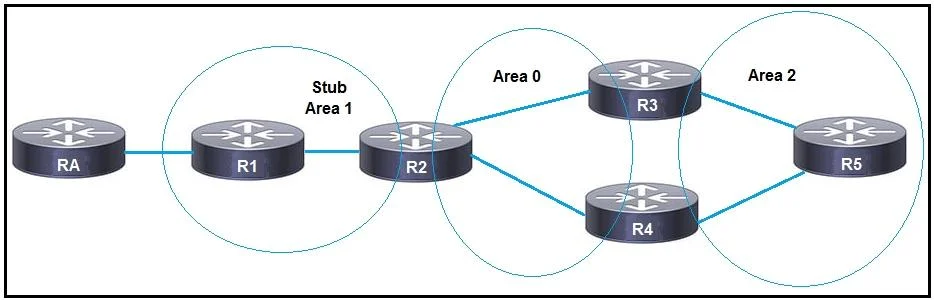
Options
- ARedistribute connected routes on R3.
- BConfigure the routers in Area 2 to be in Area 0.
- CCreate a virtual link between R1 and R2.
- DDisable stub routing in Area 1.
How the community answered
(61 responses)- A7% (4)
- B13% (8)
- C3% (2)
- D77% (47)
Explanation
OSPF stub areas are designed to reduce routing table size by blocking Type 5 LSAs (External LSAs) from entering the area, replacing them with a default route injected by the ABR. When EIGRP routes are redistributed into OSPF on R1, they become Type 5 External LSAs in the OSPF domain. If R3 resides in Area 1 which is configured as a stub area, it will never receive these Type 5 LSAs - stub areas explicitly filter them out. This explains why R3 cannot see the redistributed routes even though redistribution is correctly configured on R1. The fix is to disable stub routing in Area 1 (Option D), converting it to a normal OSPF area that accepts Type 5 LSAs, allowing redistributed EIGRP routes to propagate to R3. Option A is irrelevant because connected routes on R3 are already in the routing table. Option B would cause an OSPF backbone continuity issue. Option C (virtual link) is used to connect a non-contiguous Area 0, which is not the described problem.
Topics
Community Discussion
No community discussion yet for this question.