
300-510 · Question #242
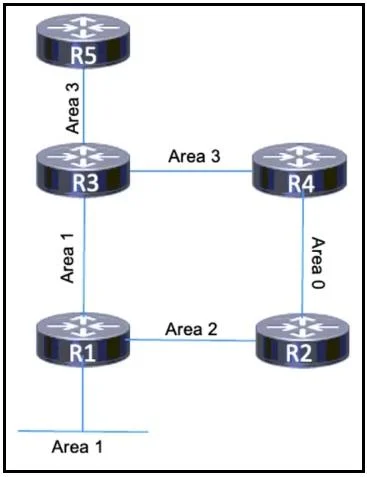
Refer to the exhibit. OSPF is running in the network, which spans multiple areas as shown, and all OSPF neighbors are established. Hosts that reside on the LAN on R1 are trying to reach a server…
The correct answer is A. Configure a virtual link between R1 and R2 to connect area 1 to area 0. Option A is correct because OSPF requires every non-backbone area to maintain a direct connection to Area 0. In this topology, Area 1 (where R1 resides) is not physically connected to Area 0, so inter-area routes from R5 are never propagated into Area 1. A virtual link between…
Question
Refer to the exhibit. OSPF is running in the network, which spans multiple areas as shown, and all OSPF neighbors are established. Hosts that reside on the LAN on R1 are trying to reach a server connected to R5, but R1 cannot reach the R5 routes. The server must maintain a TCP connection with the hosts. Which action must the engineer take to resolve the issue?
Exhibit
Options
- AConfigure a virtual link between R1 and R2 to connect area 1 to area 0.
- BConfigure a virtual link between R1 and R3 to allow area 1 to communicate to area 3.
- CConfigure a static route on R1 pointing to R3 so that traffic reaches routes connected to R5.
- DConfigure a static route on R1 and R3 that uses R5 as the next hop for traffic destined to routes
How the community answered
(42 responses)- A60% (25)
- B24% (10)
- C12% (5)
- D5% (2)
Explanation
Option A is correct because OSPF requires every non-backbone area to maintain a direct connection to Area 0. In this topology, Area 1 (where R1 resides) is not physically connected to Area 0, so inter-area routes from R5 are never propagated into Area 1. A virtual link between R1 and R2 creates a logical adjacency through a transit area, satisfying OSPF's backbone connectivity requirement and allowing full route exchange.
Option B is wrong because virtual links must always terminate in Area 0 - you cannot use them to connect two non-backbone areas (Area 1 and Area 3) to each other. This would still leave both areas isolated from the backbone.
Option C is wrong because a static route on R1 only fixes the outbound path; the return traffic from R5's server back to the hosts still has no valid path through OSPF. This breaks TCP's bidirectional requirement and doesn't address the OSPF design violation.
Option D is wrong for the same asymmetric routing reason - static routes in one direction don't solve the full end-to-end TCP session, and this is a routing architecture problem, not a missing next-hop problem.
Memory tip: Think of Area 0 as the "hub" in a hub-and-spoke wheel. Every area must connect a spoke to that hub. If a spoke is physically disconnected, a virtual link is the "extension cord" that plugs it back in - and it must always plug into the hub (Area 0), never into another spoke.
Topics
Community Discussion
No community discussion yet for this question.