
300-510 · Question #70
Drag and Drop Question Drag and drop the attributes for the BGP route selection on the left into the correct order on the right. Not all options are used. Answer:
The correct answer is highest weight; highest local preference; lowest MED; eBGP over iBGP paths; if both paths are external, prefer the oldest path; lowest router ID. This question tests the candidate's knowledge of the BGP path selection algorithm by requiring them to order key attributes in their correct evaluation sequence.
Question
Exhibit
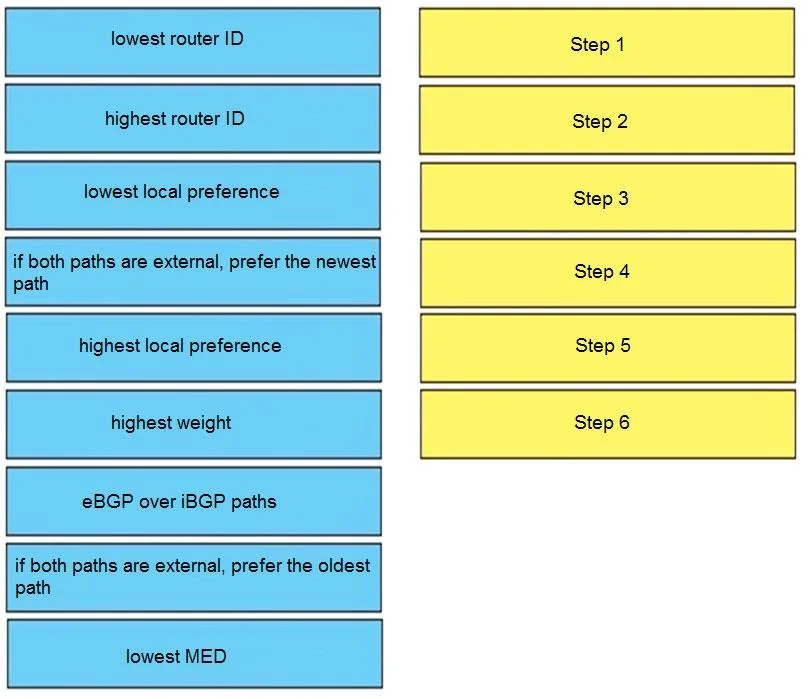
Answer Area
Drag items
Correct arrangement
- highest weight
- highest local preference
- lowest MED
- eBGP over iBGP paths
- if both paths are external, prefer the oldest path
- lowest router ID
Explanation
This question tests the candidate's knowledge of the BGP path selection algorithm by requiring them to order key attributes in their correct evaluation sequence.
Approach. The correct interaction is to drag the attributes from the left column to the right column, arranging them in the standard BGP path selection order. Based on common BGP implementations (like Cisco's), the typical order of evaluation for the provided attributes is:
- highest weight: Weight is a Cisco-specific attribute that is local to the router and has the highest precedence.
- highest local preference: Local preference is a well-known discretionary attribute used within an Autonomous System to prefer one exit path over others.
- lowest MED: Multi-Exit Discriminator is used to influence the path selection of inbound traffic into an AS from an adjacent AS. A lower MED is preferred.
- eBGP over iBGP paths: eBGP learned routes are generally preferred over iBGP learned routes for the same destination, to prevent routing loops.
- if both paths are external, prefer the oldest path: This rule helps prevent route flapping by preferring a stable, older external path over a newer one when multiple external paths exist.
- lowest router ID: If all other attributes are equal, BGP uses the lowest router ID as a tie-breaker to select the best path.
Following this sequence, the correct drag-and-drop order into the Step boxes is:
- Step 1: highest weight
- Step 2: highest local preference
- Step 3: lowest MED
- Step 4: eBGP over iBGP paths
- Step 5: if both paths are external, prefer the oldest path
- Step 6: lowest router ID
Common mistakes.
- common_mistake. Common mistakes include incorrectly understanding the 'highest' vs. 'lowest' preference for certain attributes (e.g., selecting 'highest router ID' or 'lowest local preference'). Forgetting the specific order of preference between attributes like Weight, Local Preference, and MED, or mixing up the eBGP over iBGP rule with the 'oldest path' rule, are also frequent errors. For instance, choosing 'if both paths are external, prefer the newest path' is incorrect because BGP generally prefers stable, older external paths to avoid flapping. Ignoring the specific order or misunderstanding which attributes are considered first can lead to an incorrect sequence.
Concept tested. BGP Path Selection Algorithm and its attribute evaluation order.
Topics
Community Discussion
No community discussion yet for this question.