
300-510 · Question #69
Drag and Drop Question An engineer is troubleshooting end-to-end customer traffic across an MPLS VPN service provider network. Which tasks should the engineer use to solve the routing issues? Drag…
The correct answer is RIB; LIB; LFIB; adjacency table. This question assesses the understanding of various routing and forwarding tables and their specific roles in troubleshooting an MPLS VPN network across different router types and contexts.
Question
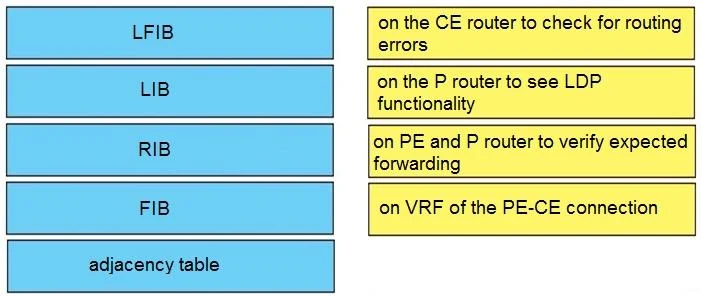
Drag and Drop Question An engineer is troubleshooting end-to-end customer traffic across an MPLS VPN service provider network. Which tasks should the engineer use to solve the routing issues? Drag and drop the table types from the left onto the most useful troubleshooting tasks/router types on the right. (Not all options are used.) Answer:
Exhibit
Answer Area
Drag items
Correct arrangement
- RIB
- LIB
- LFIB
- adjacency table
Explanation
This question assesses the understanding of various routing and forwarding tables and their specific roles in troubleshooting an MPLS VPN network across different router types and contexts.
Approach. The correct interaction involves dragging each table type to its most suitable troubleshooting task/router type as follows:
-
'on the CE router to check for routing errors' - RIB (Routing Information Base): A CE (Customer Edge) router is an IP-only router in this context. To identify issues like missing routes or incorrect next-hops, an engineer would inspect the CE's IP routing table, which is the RIB. The RIB contains all learned routes, their attributes, and the best paths, making it the primary source for diagnosing logical routing errors.
-
'on the P router to see LDP functionality' - LIB (Label Information Base): A P (Provider) router is a core MPLS Label Switch Router (LSR). It uses the Label Distribution Protocol (LDP) to exchange label mappings with its peers. The LIB stores all locally generated and received label mappings via LDP, thus providing a direct view into LDP's functionality and label bindings.
-
'on PE and P router to verify expected forwarding' - LFIB (Label Forwarding Information Base): Both PE (Provider Edge) and P routers in the MPLS core perform label switching. The LFIB is the data plane table that governs how label-switched packets are forwarded-it maps incoming labels to outgoing labels, next-hops, and interfaces. To verify the actual label-based forwarding decisions and paths, the LFIB is the definitive table.
-
'on VRF of the PE-CE connection' - FIB (Forwarding Information Base): A VRF (VPN Routing/Forwarding instance) on a PE router maintains separate IP routing and forwarding tables for each customer VPN. The PE-CE connection is an IP connection. To verify the actual IP packet forwarding decisions within that specific customer's VRF (i.e., how traffic from or to the CE is forwarded), the FIB of that VRF is used. The FIB is an optimized subset of the RIB, containing the exact next-hop information used by the data plane for fast packet forwarding.
Common mistakes.
- common_mistake. Common mistakes include confusing the roles of RIB and FIB, especially when troubleshooting 'routing errors' versus 'forwarding,' or misunderstanding the domain of MPLS-specific tables (LIB, LFIB) versus IP-specific tables (RIB, FIB). For instance, using FIB for 'routing errors' on a CE router is less precise than RIB, as the RIB contains all routing logic, while FIB is derived from it for forwarding. Similarly, applying RIB or FIB to MPLS-specific tasks like 'LDP functionality' or 'MPLS forwarding' is incorrect, as these rely on LIB and LFIB. Dragging 'adjacency table' to any of the specific troubleshooting tasks would also be incorrect because while it's foundational for Layer 3 forwarding, it's not the primary table for diagnosing routing logic, LDP, or label forwarding in the context of these specific MPLS VPN troubleshooting scenarios.
Concept tested. The core concept tested is the understanding of different routing and forwarding tables-Routing Information Base (RIB), Forwarding Information Base (FIB), Label Information Base (LIB), and Label Forwarding Information Base (LFIB)-in the context of an MPLS VPN network, including their specific functions, contents, and how they are used for troubleshooting on various router types (CE, P, PE) and within specific network contexts (LDP, VRF, IP/MPLS forwarding).
Topics
Community Discussion
No community discussion yet for this question.