
300-510 · Question #25
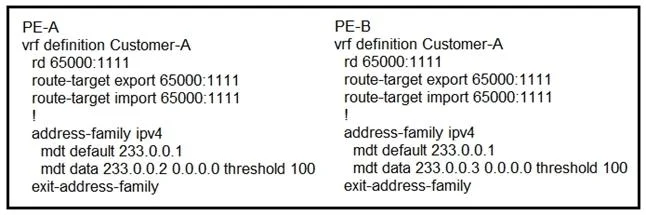
Refer to the exhibit. Which tree does multicast traffic follow?
The correct answer is B. MDT default. In MPLS Layer 3 VPN multicast (mVPN) deployments, Multicast Distribution Trees (MDTs) are used to carry multicast traffic across the provider backbone. The MDT Default tree (Option B) is the default multicast distribution tree that all PE routers in a VPN join. It carries all…
Question
Refer to the exhibit. Which tree does multicast traffic follow?
Exhibit
Options
- Ashared tree
- BMDT default
- Csource tree
- DMDT voice
How the community answered
(44 responses)- A5% (2)
- B77% (34)
- C2% (1)
- D16% (7)
Explanation
In MPLS Layer 3 VPN multicast (mVPN) deployments, Multicast Distribution Trees (MDTs) are used to carry multicast traffic across the provider backbone. The MDT Default tree (Option B) is the default multicast distribution tree that all PE routers in a VPN join. It carries all multicast traffic for a given VRF by default, even low-bandwidth or sporadic streams. The exhibit in this question depicts a scenario where traffic flows through this default MDT profile. MDT Data trees (not listed) are created dynamically for high-bandwidth streams exceeding a configured threshold to avoid burdening all PEs with large flows. Option A (shared tree) and Option C (source tree) are PIM concepts that apply within the customer or provider domain individually. Option D (MDT voice) is not a standard MDT type.
Topics
Community Discussion
No community discussion yet for this question.