
300-510 · Question #7
Refer to the exhibit. CE1 and CE2 cannot communicate through the service provider BGP peering is established between PE1 and PE2. IS-IS is the only routing protocol running in the service provider…
The correct answer is D. Verify the MPLS LSPs. In an MPLS L3VPN architecture, three planes must all function correctly: the IGP (IS-IS here) for PE loopback reachability, MP-BGP (VPNv4) for VPN route exchange, and MPLS LSPs for forwarding VPN-labeled packets across the core. The problem states BGP peering is established…
Question
Refer to the exhibit. CE1 and CE2 cannot communicate through the service provider BGP peering is established between PE1 and PE2. IS-IS is the only routing protocol running in the service provider core. What step can be done to troubleshoot the issue?
Exhibit
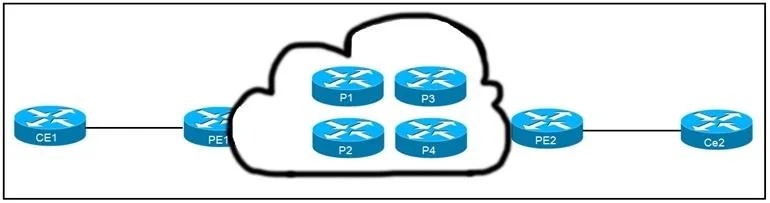
Options
- ASwitch the IGPs running in the core from IS-IS to OSPF to support a Cisco MPLS TE tunnel from
- BConfigure BGP between CE and PE routers.
- CConfirm that IS-IS is running with metric-style narrow.
- DVerify the MPLS LSPs.
How the community answered
(28 responses)- A14% (4)
- B4% (1)
- C4% (1)
- D79% (22)
Explanation
In an MPLS L3VPN architecture, three planes must all function correctly: the IGP (IS-IS here) for PE loopback reachability, MP-BGP (VPNv4) for VPN route exchange, and MPLS LSPs for forwarding VPN-labeled packets across the core. The problem states BGP peering is established between PE1 and PE2, and IS-IS is running - the control plane appears healthy. The missing piece is likely the MPLS forwarding plane: if LSPs are not properly established (e.g., LDP or RSVP-TE sessions are down, labels are not exchanged), packets from CE1 cannot be label-switched to CE2 even though routes exist in BGP. Answer A is wrong because IS-IS supports MPLS TE natively. Answer B may be relevant but the question implies CE-PE connectivity exists (BGP between PEs is established, implying PE has CE routes). Answer C (narrow metric-style) is unrelated to the forwarding failure described. Verifying MPLS LSPs (Answer D) directly addresses the forwarding-plane gap between a working control plane and broken data-plane connectivity.
Topics
Community Discussion
No community discussion yet for this question.