
300-510 · Question #8
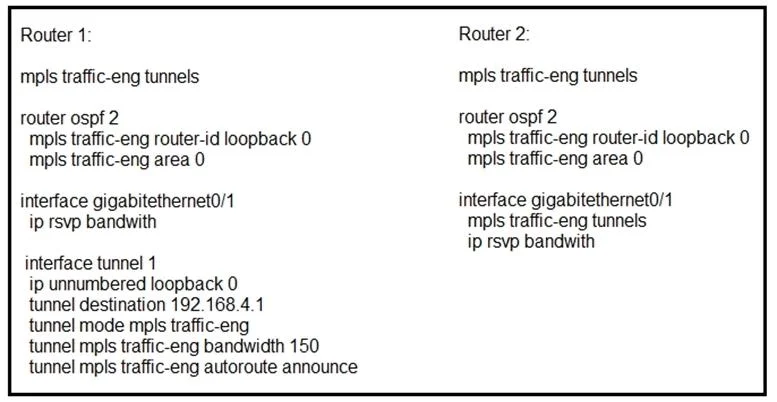
Refer to the exhibit. Router 1 has attempted to establish a Cisco MPLS TE tunnel to router 2, but the tunnel has failed. Which statement about this configuration is true?
The correct answer is D. Router 1 must have Cisco MPLS TE enabled on interface gigabitethernet0/1. For an MPLS Traffic Engineering tunnel to function, MPLS TE must be explicitly enabled on every physical interface that the tunnel traverses, in addition to the global 'mpls traffic-eng tunnels' command. If Router 1's physical egress interface (GigabitEthernet0/1) does not have…
Question
Refer to the exhibit. Router 1 has attempted to establish a Cisco MPLS TE tunnel to router 2, but the tunnel has failed. Which statement about this configuration is true?
Exhibit
Options
- ARouter 1 must define an explicit path to router 2
- BRouter 1 and router 2 must define the RSVP bandwidth reserved on the physical interfaces
- CRouter 2 must have a tunnel interface created with router 1 as the destination
- DRouter 1 must have Cisco MPLS TE enabled on interface gigabitethernet0/1
How the community answered
(31 responses)- A3% (1)
- B3% (1)
- C6% (2)
- D87% (27)
Explanation
For an MPLS Traffic Engineering tunnel to function, MPLS TE must be explicitly enabled on every physical interface that the tunnel traverses, in addition to the global 'mpls traffic-eng tunnels' command. If Router 1's physical egress interface (GigabitEthernet0/1) does not have 'mpls traffic-eng tunnels' configured under the interface, the TE tunnel cannot be signaled. The tunnel interface configuration alone on the head-end is not sufficient without interface-level enablement.
Topics
Community Discussion
No community discussion yet for this question.