
300-510 · Question #142
Refer to the exhibit. An MPLS core network has connectivity issues R4 has failed. It impacts traffic loss between R1 and R8. Customers report no access to their file servers, which delays their…
The correct answer is C. Enable MPLS ТЕ fast reroute on router R1 and Link and Node protection on router R2. MPLS Traffic Engineering Fast Reroute (TE FRR) provides pre-computed backup LSPs (Label Switched Paths) that activate within milliseconds of a failure, well before IGP reconvergence. In TE FRR, the headend router (R1) must have FRR enabled on its TE tunnel, and the Point of…
Question
Refer to the exhibit. An MPLS core network has connectivity issues R4 has failed. It impacts traffic loss between R1 and R8. Customers report no access to their file servers, which delays their transformation work. Which quick action resolves the issue until R4 recovers?
Exhibit
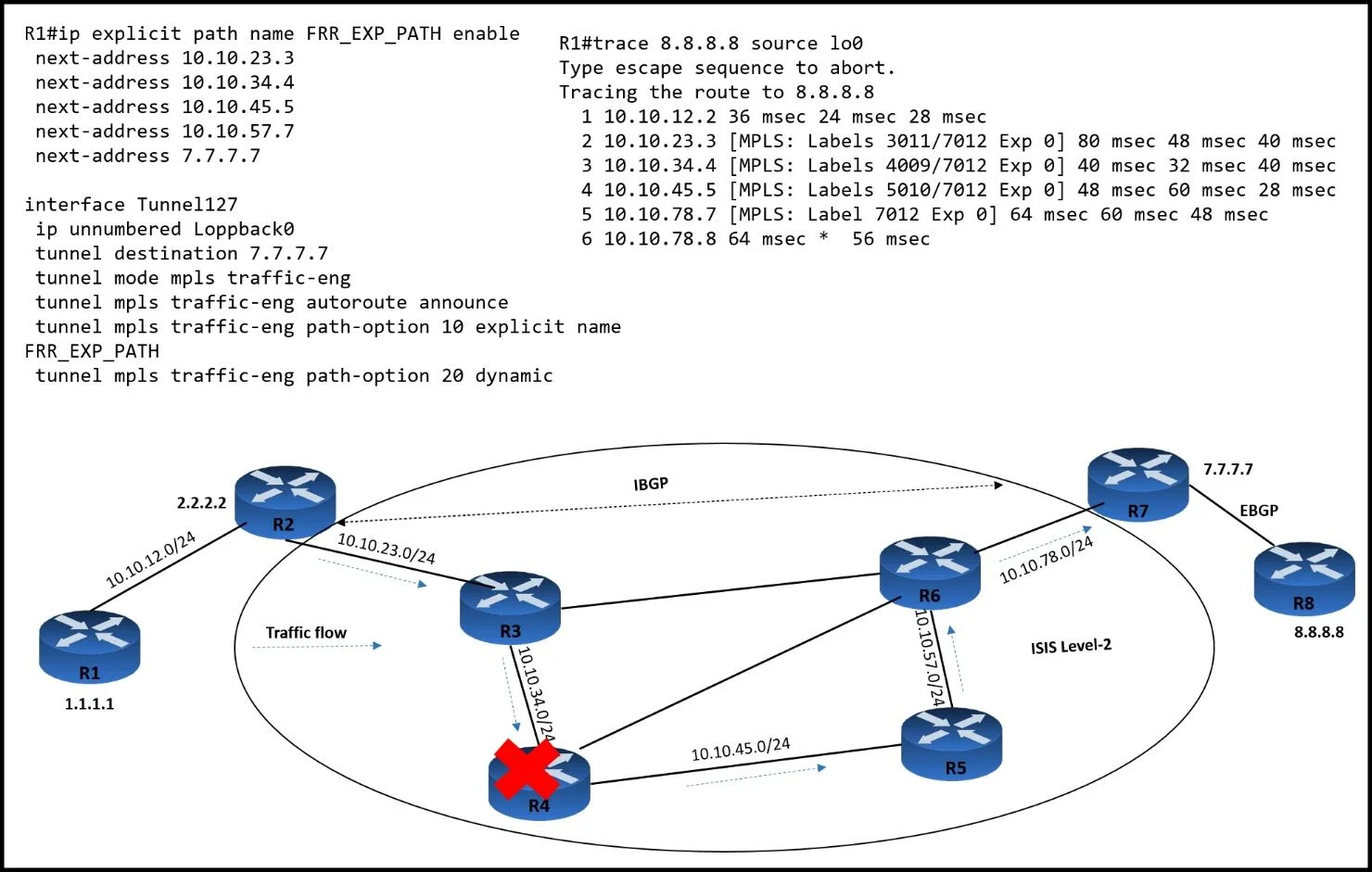
Options
- AImplement Link and Node protection on routers R2 and R7.
- BDisable traffic engineering so that traffic prefers the IGP path
- CEnable MPLS ТЕ fast reroute on router R1 and Link and Node protection on router R2.
- DConfigure IBGP full mesh for faster convergence.
How the community answered
(31 responses)- A3% (1)
- B3% (1)
- C84% (26)
- D10% (3)
Explanation
MPLS Traffic Engineering Fast Reroute (TE FRR) provides pre-computed backup LSPs (Label Switched Paths) that activate within milliseconds of a failure, well before IGP reconvergence. In TE FRR, the headend router (R1) must have FRR enabled on its TE tunnel, and the Point of Local Repair (PLR) - the router directly upstream of the failure point (R2, which is adjacent to failed R4) - must be configured with Link and Node protection. Node protection specifically covers the failure of the next-hop node (R4), rerouting traffic around the entire failed router. Option A is wrong because FRR must be enabled on the headend (R1), not just on R2. Option B would disable TE entirely and rely on slower IGP reconvergence, which does not provide a 'quick' resolution. Option D (iBGP full mesh) addresses BGP convergence, not MPLS LSP failure recovery.
Topics
Community Discussion
No community discussion yet for this question.