
300-510 · Question #141
Drag and Drop Question Drag and drop the features from the left into the order of operations for SRv6 SRH field creation and forwarding on the right. Answer:
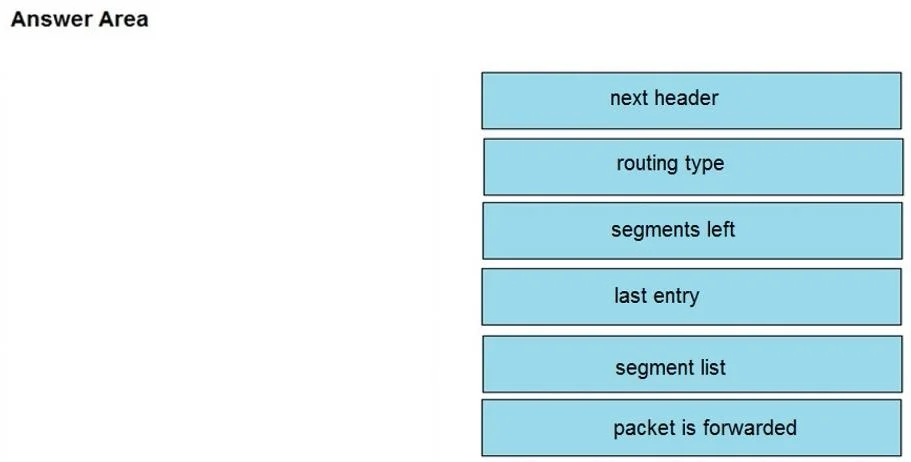
The correct answer is next header; routing type; segments left; last entry; segment list; packet is forwarded. This question tests the understanding of the SRv6 Segment Routing Header (SRH) structure and the logical order of operations for its creation and subsequent packet forwarding.
Question
Drag and Drop Question Drag and drop the features from the left into the order of operations for SRv6 SRH field creation and forwarding on the right. Answer:
Exhibit
Answer Area
Drag items
Correct arrangement
- next header
- routing type
- segments left
- last entry
- segment list
- packet is forwarded
Explanation
This question tests the understanding of the SRv6 Segment Routing Header (SRH) structure and the logical order of operations for its creation and subsequent packet forwarding.
Approach. The correct interaction is to drag the terms into the right column, ordering them based on the standard SRv6 Segment Routing Header (SRH) field structure as defined in RFC 8754, followed by the final operational step of forwarding. The correct sequence is:
- next header: This is the initial field in the SRH, indicating the type of header that immediately follows it.
- routing type: This field identifies the specific type of routing extension header (for SRv6, it's type 4).
- segments left: This critical control field indicates the number of remaining segments in the Segment List that the packet must still visit. It's decremented during processing.
- last entry: This field specifies the 0-based index of the last valid element in the Segment List.
- segment list: This is the actual array of IPv6 addresses, each representing a segment that the packet must traverse. It conceptually follows the control fields.
- packet is forwarded: This is the final action that occurs after the SRH fields have been processed and the current segment's instruction has been executed (e.g., the IPv6 Destination Address updated), leading to the packet being sent towards its next hop.
Common mistakes.
- common_mistake. Common mistakes include misordering the SRH fields, such as placing 'segment list' before its controlling fields ('segments left' or 'last entry'), or incorrectly placing 'packet is forwarded' as an SRH field rather than the subsequent action. For example, placing 'packet is forwarded' earlier in the sequence would be incorrect because it represents the result of processing the SRH, not a field within the SRH itself. Similarly, interchanging the order of 'next header' and 'routing type' or 'segments left' and 'last entry' would be wrong, as their positions in the SRH are fixed and specific according to the RFC.
Concept tested. The core technical concept tested is the detailed understanding of the SRv6 (Segment Routing over IPv6) Segment Routing Header (SRH) format, including the specific order and function of its fields, and the overall logical flow of SRv6 packet processing and forwarding.
Topics
Community Discussion
No community discussion yet for this question.