
300-510 · Question #143
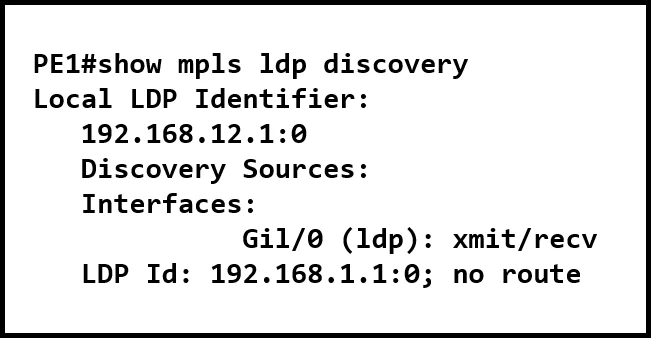
Refer to the exhibit. An administrator is troubleshooting network issues on a customer's network PE1 cannot form an LDP relationship with PE2 using LDP ID 192 168.1.1. Due to this connectivity…
The correct answer is C. Configure PE1 with a static route to 192.168.1.1. LDP (Label Distribution Protocol) sessions are established using the LDP Router ID, which is typically a loopback address. For an LDP session to form, each router must be able to reach the other's LDP Router ID in its routing table - LDP uses the Router ID as the destination…
Question
Refer to the exhibit. An administrator is troubleshooting network issues on a customer’s network PE1 cannot form an LDP relationship with PE2 using LDP ID 192 168.1.1. Due to this connectivity issue, the customer’s routes behind both PE routers cannot be exchanged. Which action must the administrator take to correct the problem?
Exhibit
Options
- AConfigure PE2 to automatically select its own LDP router ID with 192.168.1.1.
- BCreate a targeted LDP session on PE2 to override the missing routing table entry on PE1.
- CConfigure PE1 with a static route to 192.168.1.1.
- DEnable LDP session protection on the link that P1 uses as the next hop to PE2.
How the community answered
(48 responses)- A4% (2)
- B2% (1)
- C83% (40)
- D10% (5)
Explanation
LDP (Label Distribution Protocol) sessions are established using the LDP Router ID, which is typically a loopback address. For an LDP session to form, each router must be able to reach the other's LDP Router ID in its routing table - LDP uses the Router ID as the destination for TCP session establishment. If PE1 cannot find a route to PE2's LDP Router ID (192.168.1.1), the TCP session (port 646) that underpins LDP cannot be established. Configuring a static route on PE1 pointing to 192.168.1.1 resolves the reachability issue and allows LDP to form. Option A is incorrect because auto-selection of LDP Router ID on PE2 would not help if PE1 still cannot reach it. Option B (targeted LDP session) still requires IP reachability to the LDP Router ID. Option D (LDP session protection) protects an existing session from going down, but cannot create a session that never formed due to missing routing.
Topics
Community Discussion
No community discussion yet for this question.