
300-510 · Question #68
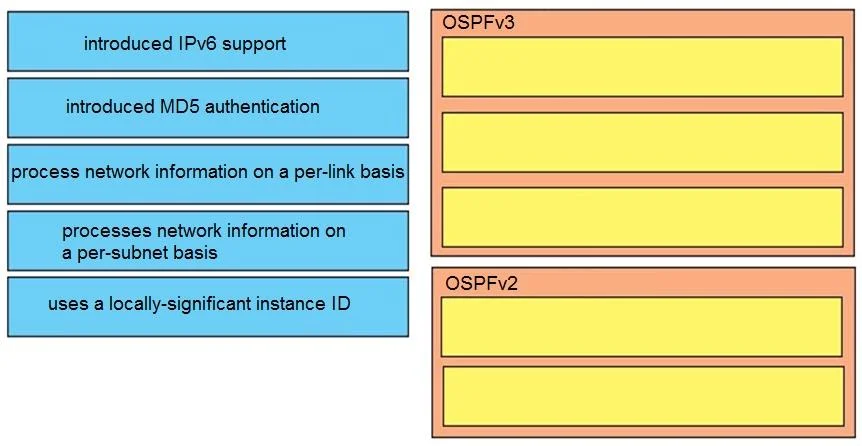
Drag and Drop Question Compare different features between OSPFv2 and OSPFv3. Drag and drop the descriptions of OSPF from the left onto the correct OSPF versions on the right. Answer:
The correct answer is introduced IPv6 support; process network information on a per-link basis; uses a locally-significant instance ID; introduced MD5 authentication; processes network information on a per-subnet basis. The question requires matching descriptions of OSPF features to their correct OSPFv2 or OSPFv3 version based on their technical characteristics.
Question
Drag and Drop Question Compare different features between OSPFv2 and OSPFv3. Drag and drop the descriptions of OSPF from the left onto the correct OSPF versions on the right. Answer:
Exhibit
Answer Area
Drag items
Correct arrangement
- introduced IPv6 support
- process network information on a per-link basis
- uses a locally-significant instance ID
- introduced MD5 authentication
- processes network information on a per-subnet basis
Explanation
The question requires matching descriptions of OSPF features to their correct OSPFv2 or OSPFv3 version based on their technical characteristics.
Approach. The correct approach is to drag each description box from the left panel to its appropriate OSPF version (OSPFv2 or OSPFv3) on the right.
For OSPFv3, the following descriptions should be placed:
- 'introduced IPv6 support': OSPFv3 was specifically designed to support IPv6 and can also run over IPv4, making it address-family independent. OSPFv2 only supports IPv4.
- 'process network information on a per-link basis': OSPFv3 decouples network information from IP addresses, associating it with links rather than specific subnets, which is crucial for its IPv6 support and address-family independence.
- 'uses a locally-significant instance ID': OSPFv3 introduced the concept of an instance ID, which is locally significant on a link, allowing multiple OSPFv3 processes to run on the same link or interface.
For OSPFv2, the following descriptions should be placed:
- 'introduced MD5 authentication': OSPFv2 supports built-in authentication using plain text or MD5. OSPFv3 removed internal authentication mechanisms, relying instead on IPsec for authentication.
- 'processes network information on a per-subnet basis': OSPFv2 operates directly on IPv4 subnets, tightly coupling the routing protocol to the IPv4 address family.
Common mistakes.
- common_mistake. A common mistake is confusing the capabilities or introductions of OSPFv2 versus OSPFv3. For example, incorrectly associating MD5 authentication with OSPFv3 (which relies on IPsec) or thinking OSPFv2 supports native IPv6 (it does not). Another error would be mixing up the 'per-link' versus 'per-subnet' processing, which is a fundamental difference in how these versions handle network topology and address information. Incorrectly placing the 'locally-significant instance ID' under OSPFv2 would also be wrong, as this feature was introduced in OSPFv3 to provide greater flexibility.
Concept tested. The core concept being tested is the understanding of the key differences and advancements between OSPFv2 and OSPFv3, specifically regarding their support for IP versions (IPv4 vs. IPv6), authentication mechanisms, handling of network information (per-link vs. per-subnet), and process identification (instance ID).
Topics
Community Discussion
No community discussion yet for this question.