
300-510 · Question #67
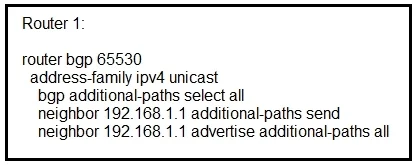
Refer to the exhibit. Which statement about this configuration is true?
The correct answer is D. Router 1 receives only the best path from neighbor 192.168.1.1. Without any BGP multipath or additional-paths configuration applied to the neighbor relationship with 192.168.1.1, standard BGP behavior applies: BGP selects a single best path using its decision process and installs only that one path. The 'maximum-paths' and…
Question
Refer to the exhibit. Which statement about this configuration is true?
Exhibit
Options
- ARouter 1 sends and receives multiple best paths from neighbor 192.168.1.1
- BRouter 1 sends up to two paths to neighbor 192.168.1.1 for all routes
- CRouter 1 receives up to two paths from neighbor 192.168.1.1 for all routes in the same AS
- DRouter 1 receives only the best path from neighbor 192.168.1.1
How the community answered
(39 responses)- A5% (2)
- C3% (1)
- D92% (36)
Explanation
Without any BGP multipath or additional-paths configuration applied to the neighbor relationship with 192.168.1.1, standard BGP behavior applies: BGP selects a single best path using its decision process and installs only that one path. The 'maximum-paths' and 'additional-paths' features must be explicitly configured to allow BGP to send or receive multiple paths. Since neither is shown in the exhibit's configuration, Router 1 receives only the single best path from neighbor 192.168.1.1. Option A requires 'additional-paths send/receive' on both ends; Option B would require 'neighbor ... additional-paths send N'; Option C would require 'neighbor ... additional-paths receive' plus same-AS multipath settings.
Topics
Community Discussion
No community discussion yet for this question.