
S90-09A · Question #36
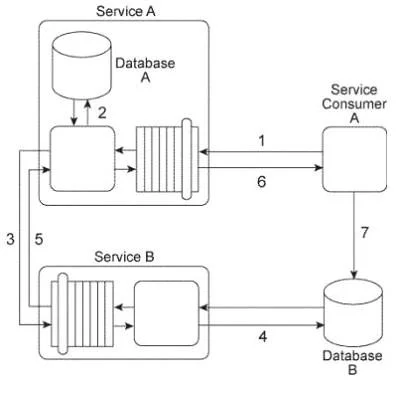
Service Consumer A sends a message with a business document to Service A (1), which writes the business document to Database A (2). Service A then forwards the business document to Service B (3)…
Sign in or unlock S90-09A to reveal the answer and full explanation for question #36. The question stem and answer options stay visible for context.
Question
Service Consumer A sends a message with a business document to Service A (1), which writes the business document to Database A (2). Service A then forwards the business document to Service B (3), which writes the business document to Database B (4). Service B then responds to Service A with a message containing a failure or success code (5) after which Service A responds to Service Consumer A with a message containing a failure or success code (6). Upon receiving the message, Service Consumer A updates a log table in Database B (7). The log entry is comprised of the entire business document. Database A is dedicated to the Service A service architecture and Database B is a shared database. There are two problems with this service composition architecture that you are asked to address:
First, both Service Consumer A and Service B need to transform the business document data from an XML format to a proprietary Comma Separated Value (CSV) in order to write the data to Database B. This has led to redundant data format transformation logic that has been difficult to keep in synch when Database B changes. Secondly, Service A is an entity service that is being reused by several other service compositions. It has lately developed reliability problems that have caused the service to become unavailable for extended periods. What steps can be taken to solve these problems?
Exhibit
Options
- AThe Legacy Wrapper pattern can be applied so that data access to Database B is separated into a
- BThe Legacy Wrapper pattern can be applied so that data access to Database B is separated into a
- CThe service composition can be redesigned with the application of the Contract Centralization
- DNone of the above.
Unlock S90-09A to see the answer
You've previewed enough free S90-09A questions. Unlock S90-09A for full answers, explanations, the timed quiz mode, progress tracking, and the master PDF. Question stem and options stay visible so you can still see what's on the exam.