
PL-200 · Question #249
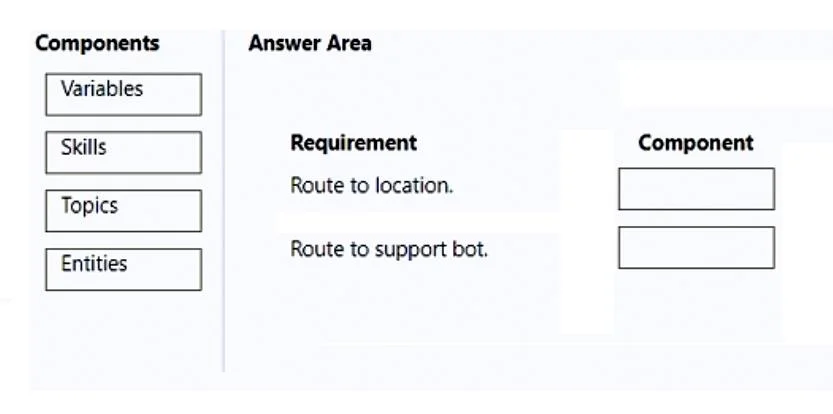
Drag and Drop Question A company plans to create a Power Virtual Agents chatbot. The bot has the following requirements: - Prompt for a location of the customer and the call must be routed to a…
The correct answer is Topics; Skills. This question assesses the test-taker's understanding of Power Virtual Agents components and their appropriate use cases for managing conversational flows, extracting information, and integrating with external bot frameworks.
Question
Exhibit
Answer Area
Drag items
Correct arrangement
- Topics
- Skills
Explanation
This question assesses the test-taker's understanding of Power Virtual Agents components and their appropriate use cases for managing conversational flows, extracting information, and integrating with external bot frameworks.
Approach. For the first requirement, 'Route to location.', the correct component is 'Topics'. Topics define the conversational paths within Power Virtual Agents, including prompting for user input (like a location), processing that input, and then performing actions such as routing the call to a support agent. Defining a specific conversation flow based on user input (like location) and then directing the call falls under the responsibility of a Topic.
For the second requirement, 'Route to support bot.', the correct component is 'Skills'. Power Virtual Agents bots can be extended by integrating with 'Skills'. A Skill is essentially an external capability, often implemented as an Azure Bot Framework bot, that a Power Virtual Agents bot can invoke. Transferring a support call to a separate 'support bot that uses the Bot Framework' is a classic use case for extending the PVA bot's capabilities via a Skill.
Common mistakes.
- common_mistake. Using 'Variables' or 'Entities' for routing logic: While variables store information (like the customer's location) and entities help identify and extract that information from user input, they do not define the conversational flow or routing logic itself. A Topic utilizes variables and entities but is the primary component for controlling the conversation flow.
Confusing 'Skills' with 'Topics' for internal routing: A common mistake is to think that 'Skills' are for internal branching logic, but 'Skills' are specifically designed for extending the bot's capabilities by integrating with external services or other bots (like a Bot Framework bot). 'Topics' handle the internal conversation flow and branching.
Using 'Topics' for external bot integration: A Topic defines the conversation within the PVA bot. While it can initiate a transfer to an agent, transferring to an external Bot Framework bot explicitly requires the integration capabilities provided by a Skill, not just a standard Topic action.
Concept tested. The core concept being tested is the understanding of key Power Virtual Agents components - specifically, Topics for managing conversational flows and actions, Entities for information extraction, Variables for data storage, and Skills for extending bot capabilities through integration with external Bot Framework bots or services.
Topics
Community Discussion
No community discussion yet for this question.