
PL-100 · Question #303
Drag and Drop Question You are designing an app to track time off for employees. Employee data, including employee ID number, is stored in an existing data source used by other apps. Employees must…
The correct answer is Record reference; View. To store new time-off requests, a Table is required, and to link these requests to existing employee data, a Record reference is used for the employee ID.
Question
Exhibit
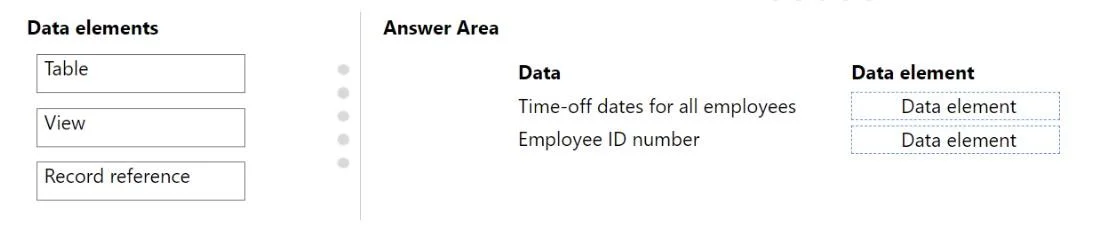
Answer Area
Drag items
Correct arrangement
- Record reference
- View
Explanation
To store new time-off requests, a Table is required, and to link these requests to existing employee data, a Record reference is used for the employee ID.
Approach. 1. For 'Time-off dates for all employees': The scenario states that employees must be able to 'enter time-off start and end dates in the app'. This indicates new data that needs to be stored. A 'Table' is the fundamental data element used to store a collection of structured records, such as individual time-off requests. Therefore, 'Table' should be dragged to 'Time-off dates for all employees'. 2. For 'Employee ID number': The scenario mentions that 'Employee data, including employee ID number, is stored in an existing data source' and 'Employees must be able to look up their employee ID number'. When designing the new time-off app, each time-off record needs to be associated with a specific employee from the existing data source. This is achieved by creating a relationship between the new time-off table and the existing employee table. In data modeling, particularly in platforms like Dataverse or Power Apps, this relationship is typically managed using a 'Record reference' (also known as a lookup column or foreign key). This 'Record reference' column in the time-off table would point to the primary key (Employee ID) of a record in the existing employee table. Therefore, 'Record reference' should be dragged to 'Employee ID number'.
Common mistakes.
- common_mistake. 1. Dragging 'View' to 'Time-off dates for all employees': A View is typically used to display existing data, often filtered or combined from multiple tables, and is generally not used for storing new, transactional data that the app will create or modify.
- Dragging 'Record reference' to 'Time-off dates for all employees': 'Time-off dates' represent the primary data being tracked by the app, not a reference to another record. They require their own storage structure, which is a table.
- Dragging 'Table' to 'Employee ID number': The employee ID number itself is a field within an existing employee table. While that table is a 'Table', the new time-off data needs to link to or reference a specific employee record, not create a new table for just the employee ID within the time-off context. A 'Record reference' is the mechanism for this cross-table linkage.
Concept tested. Data modeling principles, understanding of data element types (Table, View, Record reference/Lookup) in the context of application development, and how to establish relationships between data entities, especially when integrating with existing data sources.
Topics
Community Discussion
No community discussion yet for this question.