
MS-900 · Question #312
Hotspot Question Instructions: For each of the following statements, select Yes if the statement is true. Otherwise, select No. NOTE: Each correct selection is worth one point. Answer:
The correct answer is Microsoft Intune allows companies to manage users' personal devices that have been enrolled in Azure AD. = Yes; Microsoft Intune allows companies to manage organization-owned phones. = Yes; Microsoft Intune can use Conditional Access policies. = Yes. This hotspot question tests knowledge of Microsoft Intune's core capabilities, including managing personal and organization-owned devices, and its integration with Azure AD Conditional Access policies.
Question
Exhibit
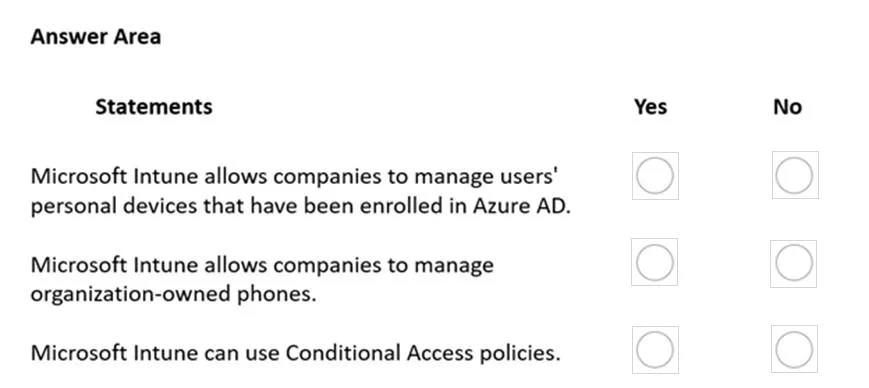
Answer Area
- Microsoft Intune allows companies to manage users' personal devices that have been enrolled in Azure AD.Yes
- Microsoft Intune allows companies to manage organization-owned phones.Yes
- Microsoft Intune can use Conditional Access policies.Yes
Explanation
This hotspot question tests knowledge of Microsoft Intune's core capabilities, including managing personal and organization-owned devices, and its integration with Azure AD Conditional Access policies.
Approach. The correct interaction is to select 'Yes' for all three statements. Each statement accurately describes a function or capability of Microsoft Intune:
-
Statement: Microsoft Intune allows companies to manage users' personal devices that have been enrolled in Azure AD.
- Correct Selection: Yes. Microsoft Intune supports Bring Your Own Device (BYOD) scenarios. Users can enroll their personal devices (smartphones, tablets, laptops) into Intune, which often involves registering the device with Azure AD. Intune can then apply Mobile Application Management (MAM) policies to protect corporate data within apps on these personal devices, or even Mobile Device Management (MDM) policies for a more comprehensive management approach, while respecting user privacy.
-
Statement: Microsoft Intune allows companies to manage organization-owned phones.
- Correct Selection: Yes. One of Intune's primary functions as a Unified Endpoint Management (UEM) solution is to manage corporate-owned devices. This includes phones (iOS, Android), tablets, and other endpoints. Companies can use Intune to enroll, configure, deploy apps, enforce security policies, and monitor the compliance of their organization-owned phones.
-
Statement: Microsoft Intune can use Conditional Access policies.
- Correct Selection: Yes. Microsoft Intune integrates seamlessly with Azure AD Conditional Access. Intune's device compliance policies are a crucial component of Conditional Access. Conditional Access policies can be configured to require devices to be 'compliant' (as determined by Intune) before granting access to corporate resources and cloud apps, thereby enhancing security.
Common mistakes.
- common_mistake. Selecting 'No' for any of these statements would be incorrect. A common mistake might stem from a limited understanding of Intune's full feature set or its interaction with other Microsoft 365 services. For instance, some might believe Intune only manages corporate devices and not personal ones (failing to recognize BYOD/MAM capabilities), or they might not fully grasp the integration between Intune's device compliance and Azure AD Conditional Access policies. Misunderstanding that Intune is central to both corporate device management and securing access from personal devices could lead to incorrect 'No' answers.
Concept tested. The core concept being tested is the comprehensive understanding of Microsoft Intune's capabilities as a Unified Endpoint Management (UEM) solution. This includes Mobile Device Management (MDM), Mobile Application Management (MAM), support for both corporate-owned and Bring Your Own Device (BYOD) scenarios, and its integration with Azure Active Directory (Azure AD) Conditional Access for enforcing device compliance and secure access policies.
Topics
Community Discussion
No community discussion yet for this question.