MB-800 · Question #79
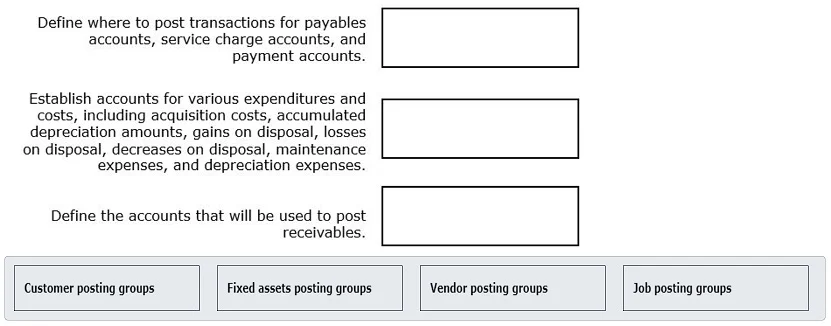
Drag and Drop Question You are working for a company that wants to map their vendor invoices. They also want to check the disposal acquisition expenses related to certain purchases and define the acco
The correct answer is Vendor posting groups; Fixed assets posting groups; Customer posting groups. Posting Groups in Microsoft Dynamics 365 Business Central This question tests your knowledge of which posting group handles each business scenario. There are three requirements mapped to three posting groups, with Job posting groups being unused. --- Requirement 1 → Vendor Postin
Question
Exhibit
Answer Area
Drag items
Correct arrangement
- Vendor posting groups
- Fixed assets posting groups
- Customer posting groups
Explanation
Posting Groups in Microsoft Dynamics 365 Business Central
This question tests your knowledge of which posting group handles each business scenario. There are three requirements mapped to three posting groups, with Job posting groups being unused.
Requirement 1 → Vendor Posting Groups
Scenario: Map vendor invoices
Why: Vendor posting groups link vendors to the G/L (general ledger) accounts used when posting vendor transactions - purchase invoices, credit memos, and payments. They define the payables account, purchase discount accounts, and service charge accounts. When you post a vendor invoice, Business Central looks up the vendor's assigned posting group to know where to record the liability.
Common mistake: Confusing this with Customer posting groups. Remember: vendors = payables (money you owe); customers = receivables (money owed to you).
Requirement 2 → Fixed Assets Posting Groups
Scenario: Check disposal/acquisition expenses related to certain purchases
Why: Fixed Asset posting groups define the G/L accounts for all fixed asset lifecycle transactions - including acquisition cost, accumulated depreciation, write-downs, and critically, disposal gains/losses. Both acquisition and disposal are fixed-asset-specific events, making this the only posting group designed to track those expense/revenue entries.
Common mistake: Assuming vendor posting groups cover asset purchases. Even if you buy a fixed asset through a purchase invoice (vendor), the asset-side posting (what account it lands in, depreciation, disposal) is controlled by the Fixed Asset posting group, not the vendor one.
Requirement 3 → Customer Posting Groups
Scenario: Define the accounts used to post transactions
Why: Customer posting groups define the G/L accounts for customer-side transactions - receivables, payment discount accounts, interest/finance charge accounts, etc. They control where customer transactions are posted in the ledger.
Common mistake: This requirement sounds generic ("define accounts for posting transactions"), which tempts people to pick Vendor posting groups. The key distinction in the exam context is that this requirement is about the customer/receivables side of the ledger, not the payables side.
Why Job Posting Groups is Not Used
Job posting groups are for project management scenarios - they define how job costs and revenues flow to the G/L. None of the three requirements involve project/job tracking, so this option is a distractor.
Quick Reference
| Requirement | Posting Group | Core Purpose |
|---|---|---|
| Map vendor invoices | Vendor posting groups | Payables G/L accounts |
| Disposal/acquisition expenses | Fixed assets posting groups | Asset lifecycle G/L accounts |
| Define accounts for transactions | Customer posting groups | Receivables G/L accounts |
| (unused) | Job posting groups | Project cost/revenue G/L accounts |
Topics
Community Discussion
No community discussion yet for this question.