nerdexam
Microsoft

MB-335 · Question #198

Drag and Drop Question A company uses Process manufacturing. You need to review formulas and how the different ingredient types impact the batch balancing process. Which ingredient types should you…

The correct answer is Active; Compensating. Process Manufacturing: Ingredient Types in Batch Balancing (Dynamics 365 SCM) This question comes from Microsoft Dynamics 365 Supply Chain Management (MB-335 exam domain), covering Process Manufacturing formula management. --- The Four Ingredient Types | Type | Role in Batch…

Configure production prerequisites

Question

Drag and Drop Question A company uses Process manufacturing. You need to review formulas and how the different ingredient types impact the batch balancing process. Which ingredient types should you use? To answer, drag the appropriate ingredient types to the correct scenarios. Each ingredient type may be used once, more than once, or not at all. You may need to drag the split bar between panes or scroll to view content. NOTE: Each correct selection is worth one point. Answer:

Exhibit
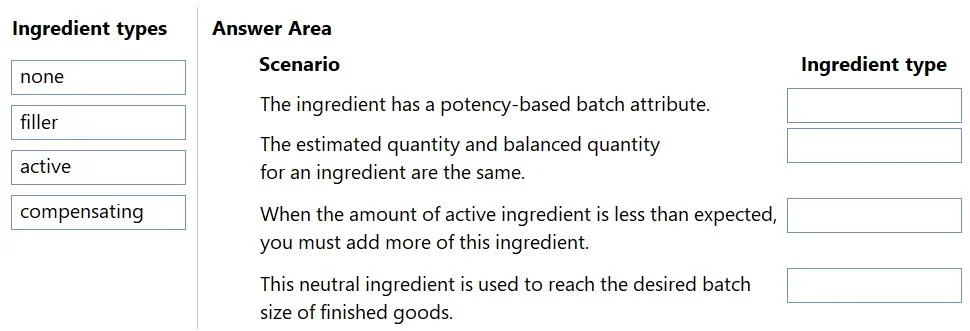
MB-335 question #198 exhibit

Answer Area

Drag items

NoneActiveCompensatingFiller

Correct arrangement

  • Active
  • Compensating

Explanation

Process Manufacturing: Ingredient Types in Batch Balancing (Dynamics 365 SCM)

This question comes from Microsoft Dynamics 365 Supply Chain Management (MB-335 exam domain), covering Process Manufacturing formula management.


The Four Ingredient Types

TypeRole in Batch Balancing
NoneStandard ingredient - no special balancing behavior
ActiveDrives the batch quantity calculation; quantity varies by potency
CompensatingOffsets variation in the Active ingredient to keep the formula balanced
FillerFills remaining quantity to reach the total batch size

Why Each Answer is Correct

Position 1 → Active

The Active ingredient is the one whose real-world quantity fluctuates based on potency or concentration. For example, a raw chemical might be 95% pure one batch and 98% the next. By marking it Active, the system uses its actual effective quantity as the basis for recalculating the entire formula. It answers the scenario: "Which ingredient type determines how the batch quantity is driven?"

Position 2 → Compensating

The Compensating ingredient reacts inversely to the Active ingredient. When the Active ingredient quantity decreases (because potency is higher), the Compensating ingredient increases by the same delta to preserve the total batch weight/volume. It answers: "Which ingredient type adjusts to offset the variation caused by the Active ingredient?"


Common Mistakes

  • Confusing Compensating with Filler: Filler just pads the total to hit a target quantity - it does not react to Active ingredient changes. Compensating specifically offsets Active ingredient variance.
  • Using None thinking it's a default Active: None has zero special balancing logic. It won't drive or react to batch recalculation.
  • Assuming only one Active per formula: You can technically have multiple ingredients flagged, but only one Active ingredient is the standard design pattern - it's the single source of truth for batch sizing.

Topics

#batch balancing#ingredient types#process manufacturing#formula configuration

Community Discussion

No community discussion yet for this question.

Full MB-335 Practice